The upcoming vote on State Question 832 is sparking significant concern across Oklahoma’s small business sector, with industry leaders warning of sweeping economic consequences. Farm Director KC Sheperd recently sat down with Jerrod Shouse, the State Director of the National Federation of Independent Business (NFIB), to discuss the potential impacts of State Question 832 on small businesses and the agricultural community. As the state prepares to head to the polls, the measure presents a critical turning point for local employers.
“State Question 832 will be in front of a vote of the people here in just a matter of days,” Shouse explained. “It raises the minimum wage from the current federal minimum wage that we have in this state, seven plus dollars, to 15, and then it continues to go up based on the consumer price index.”
The NFIB, a small-business association that has operated for over 80 years, represents between 3,000 and 4,000 small-business owners across Oklahoma. To determine its stance on the issue, the organization conducted internal member ballots both in 2024 and again recently.
“Overwhelmingly, when we asked our members, ‘Should we support or oppose this ballot initiative?’ overwhelmingly the answer was no,” Shouse said. “We should oppose this ballot initiative because of how it would affect small business owners.”
The Ripple Effect on “Mom and Pop” Operations
Shouse emphasized that the vast majority of small businesses—often referred to as mom-and-pop shops or Main Street operations—are distributed throughout all 77 counties of Oklahoma. These entities, which may employ anywhere from two to 20 individuals, serve their local communities directly. While many already pay above the minimum wage in response to market demand, a government-mandated increase poses a severe challenge.
“When the government comes in and says, ‘You must pay this wage that is a new wage that is, let’s say, double what you’re paying now,’ that’s going to have a crazy effect on how their business operates,” Shouse noted. “Where’s that money going to come from? They may have to raise rates. They may have to raise the price of the food they’re selling. They may have to raise the price of the products that are in their stores.”
Beyond driving up prices for consumers, Shouse warned that business owners would likely face difficult choices regarding their workforces.
“They may have to cut back hours,” Shouse stated. “They may not be able to hire—when somebody leaves for another job, they may not be able to replace them. So it has a lot of effects on a small business that, frankly, a larger business may or may not be able to absorb. But it’s really going to hit small business owners just squarely right in the jaw.”
Agricultural Impact and the Elimination of Exemptions
During the conversation, Sheperd pointed out a frequently overlooked reality: agricultural operations are fundamentally small businesses, meaning the measure will significantly impact the farming and ranching sectors.
Shouse, who grew up in a small town surrounded by agriculture, strongly agreed, noting that he has hauled hay and participated in farm work himself. He highlighted that operating outside city limits does not exempt a farm or ranch from the realities of small business economics.
“The state question gets rid of a lot of the exemptions that are related to ag, and that’s going to be really difficult for our small family farmers and ranchers out in the rural areas,” Shouse warned.
Rural producers are already managing a highly volatile economic environment, compounding the pressure of a mandated wage increase.
“They are also dealing with price increases—increase in fuel, increase in equipment,” Shouse explained. “Those sorts of things are cutting into their costs, and an increase in the amount of wages they’re going to have to pay are going to make that even tougher for them.”
The Mandate of a “Forever” Price Hike
While proponents argue that a higher minimum wage would provide an immediate economic boost by placing more money into workers’ pockets, the NFIB argues that the structural mechanics of the state question will trigger long-term economic instability. The primary concern lies in linking the wage floor directly to inflation metrics.
“It sounds good, right? Having a little bit extra money in your pocket,” Shouse acknowledged. “That may be a short-term positive, but when you tie this to the consumer price index, meaning what is inflation doing? If inflation goes up 1.3% or 4.1% year-over-year, then the minimum wage is going to go up, too. So this is going to go up forever. It’s not just a guess; it is reality. The consumer price index goes up every single year, and therefore so will the minimum wage.”
This indexation creates a continuous upward shift that affects even those employers who currently pay well above the current minimum floor. Shouse recalled a recent conversation with a small business owner in Stillwater who currently pays staff members between $15 and $20 an hour.
“When the floor rate goes up, and it’s going to double… everybody else is going to expect a pay raise too,” Shouse said. “So even if you were paying above the minimum wage, that shifts the entire market upward. If you’re already paying $10 above the minimum wage, those small business owners are going to feel that, to keep their employees where they are, they’ll need to pay above the minimum wage themselves. So even if you’re paying above the minimum wage, there’s still going to be pressure to pay more.”
Shouse reiterated that Oklahoma business owners generally try to establish fair rates based on local economic sectors and geographic realities, ensuring their teams can make a comfortable living. However, an artificial market shift disrupts that localized balance.
Long-Term Consequences for Jobs and Innovation
The structural adjustments required to absorb these higher labor costs are expected to fundamentally alter Oklahoma’s entry-level job market. Shouse shared a personal example, noting that his daughter secured her first job at age 16, earning minimum wage.
“She loved it, and it was a good entry-level opportunity for her,” Shouse reflected. “I think we’re going to see a lot of that dry up, because companies that can afford to take a risk on a 16-year-old student and pay them $8 an hour, $10 an hour—everything now that’s $15 an hour, those sorts of jobs I think we’re going to see go away.”
Furthermore, the pressure of escalating operational costs is accelerated by an ongoing transition toward automated systems, a trend that could see a marked increase if the measure passes.
“You’re already seeing a move toward automation,” Shouse observed. “Nobody loves to see a robot do a job, or whenever you have to do self-checkout, those things. I think we’re going to see more of that, unfortunately, because the small business owners and the big business owners are going to see that you’ve got to start finding a way long-term to make the economics work when it comes to these sorts of things.”
Ultimately, the constraint on financial margins reduces the capital available for business development, hiring, and localized growth.
“I think you’re going to see places that maybe have 12 employees, they may only have nine going forward, and maybe they’re going to have to reduce their hours,” Shouse said. “Small business owners… are going to have to find ways to make this work economically. Their margins are already thin; they already don’t have a lot of money to pay their employees, to begin with. And they’re trying to save for like, maybe some new equipment. Maybe I need to buy a new bulldozer, maybe I need to buy a new vehicle for my fleet. Maybe I’m trying to open a second location. This is going to cut into all those sorts of things, and I think what you’re going to see is businesses that are honestly trying to grow and expand, this is going to have a chilling effect on them as well.”
Looking Ahead to Early Voting
With early voting scheduled to begin on June 11, the NFIB is urging voters to consider the long-term, systemic impacts on the state’s economic foundation before casting their ballots.
“For us, the answer is vote no,” Shouse concluded. “There are other ways we can try to address how we increase wages and put more money in people’s pockets. NFIB has long supported a fairer tax base; we’ve long supported fewer regulations, which we feel help small business owners grow their business and be able to pay their employees more. This is not the right answer, so we’re asking Oklahomans to please vote no.”
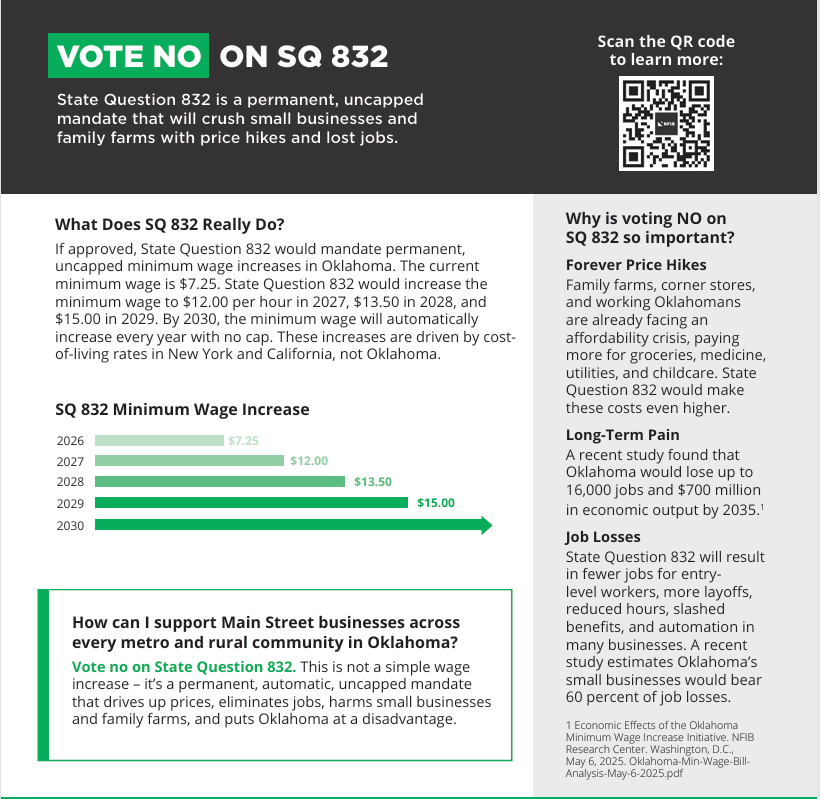
For more information, you can click here: