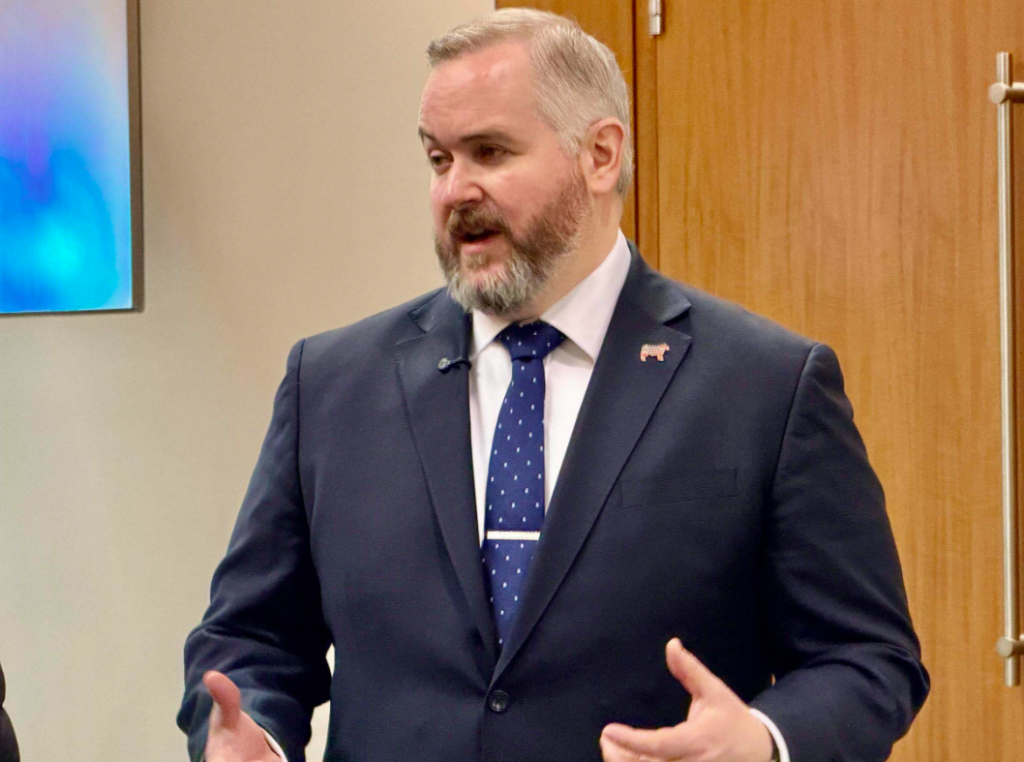
In today’s Beef Buzz, Senior Farm and Ranch Broadcaster Ron Hays speaks with Kent Bacus, executive director of government affairs for the National Cattlemen’s Beef Association, about expanding export opportunities in Asia, restoring market access to China, and the future of the U.S.-Mexico-Canada Agreement.
Diversifying Beyond China
Bacus said NCBA is encouraged by the Trump administration’s efforts to strengthen trade relationships throughout Asia, particularly as the industry looks to reduce its dependence on China. “We’re really excited about the administration continuing to engage with a lot of the Asian markets and trying to open up more market access there,” Bacus said. “We’ve seen a lot of progress with Taiwan, with Indonesia. We’re hoping to see more progress with Vietnam, Malaysia and Thailand.”
While China remains an important customer, Bacus said relying too heavily on a single market leaves U.S. cattle producers vulnerable. “China is a big market. It’s been good for a couple of years. It was a $1.6 billion market, but it’s China,” he said. “China can turn off that access for political reasons anytime they want to. That’s exactly what we’ve seen over the last couple of years.”
Because of that uncertainty, Bacus said expanding access across Southeast Asia is essential. “We’ve got to catch up with all of our competitors who have better access into Southeast Asia,” he said. “Australia, New Zealand, even Canada, they’re cleaning our clocks in Southeast Asia right now simply because they’ve got better trade deals and better access.”
Finding More Value for Every Animal
Bacus said export growth isn’t just about selling more beef—it’s about creating value for products that have limited demand in the domestic market. “Most of what we’re going to export is stuff that it’s just not going to sell here in the United States,” he explained. “When we look at all of that, we want to sell to the highest bidder. We want to be very competitive. We want to create more opportunities for cattle producers.”
He said losing access to China has had ripple effects throughout the industry. “Not having that competitive access has really hurt,” Bacus said. “We’ve seen processing capacity diminish. We’ve seen feeding capacity diminish, and that’s made us less competitive overall.”
Exports traditionally add significant value to every animal marketed, but that premium has declined. “When we look at the value add for exports, exports alone traditionally add about $450 per head,” he said. “That dropped to less than $390 per head last year.”
With production costs continuing to rise, Baccus said improving trade opportunities is critical. “We need to be as competitive as possible. We need to be as profitable as possible, and expanding those markets and being able to capitalize on it is what really drives that producer premium.”
China Progress, But More Work Ahead
Bacus said one of the biggest recent accomplishments has been China’s decision to restore export certificates for hundreds of U.S. beef processing plants. “A major accomplishment was China finally restoring those export certificates for over 400 processing plants,” he said.
However, challenges remain. “We still have over 30 plants that are delisted or restricted because of claims of residue violations,” Backus said. “They’ll never show you the test results. They’ll never show you how they arrived at any of this.”
He believes long-term success depends on more predictable trade rules. “We need clear, transparent rules of trade. We need some enforceability there. We need a trade partner we can trust, and right now we don’t have one.”
Bacus said NCBA hopes full market access can be restored later this year while also strengthening relationships with China’s neighboring countries. “We think we can definitely get back into the market, but we need to be in there long term,” he said. “We need predictability, stability to incentivize more consumer development in a major market.”
USMCA Review Underway
Beyond Asia, Bacus said NCBA is closely watching the ongoing review of the U.S.-Mexico-Canada Agreement. Although the three countries did not agree to extend the agreement this summer, he emphasized that producers should not view that as an immediate threat. “That doesn’t mean that the agreement’s going away,” Bacus said. “We still have a trade agreement. We still have unrestricted, duty-free access for beef and cattle.”
Instead, he said the current negotiations are focused on ensuring Canada and Mexico fulfill their existing commitments. “This is the Trump administration having to play hardball with Canada and Mexico, who have not fulfilled some of the terms that they agreed to under the USMCA,” Bacus said. “Really, this is about accountability.”
Bacus also reiterated NCBA’s opposition to mandatory country-of-origin labeling requirements. “It’s honestly a solution in search of a problem,” he said. “We already have a USMCA that is full of much bigger trade issues, actual trade issues that are affecting farmers and ranchers.”
As negotiations continue, Bacus said NCBA’s focus remains on preserving open markets and securing new opportunities that strengthen profitability for U.S. cattle producers.
The Beef Buzz is a regular feature heard on radio stations around the region on the Radio Oklahoma Ag Network and is a regular audio feature found on this website as well. Click on the LISTEN BAR above for today’s show and check out our archives for older Beef Buzz shows covering the gamut of the beef cattle industry today.