According to the Mesonet Ticker (https://ticker.mesonet.org/), Gary McManus writes that the Climate Prediction Center placed Oklahoma in the dreaded “rapid onset of drought risk” area. He also expects temperatures to be above normal for the next few weeks. With the very hot and dry weather occurring across parts of Oklahoma, livestock producers should be closely monitoring their ponds for blue-green algae issues.
Blue-green algae is not really an algae but a bacterium which is referred to as cyanobacterium. The most common species found in the Midwest are Microcystis, Oscillatoria, and Anabaena. The bacterium is found in most bodies of water; however, they become a problem during times of rapid growth which is fueled by high nitrogen and phosphorus content and warm sunny weather. Most issues with cyanobacterium occur in summer and fall months, but high toxin release may occur anytime of the year. Cases have been found in Oklahoma as early as March.
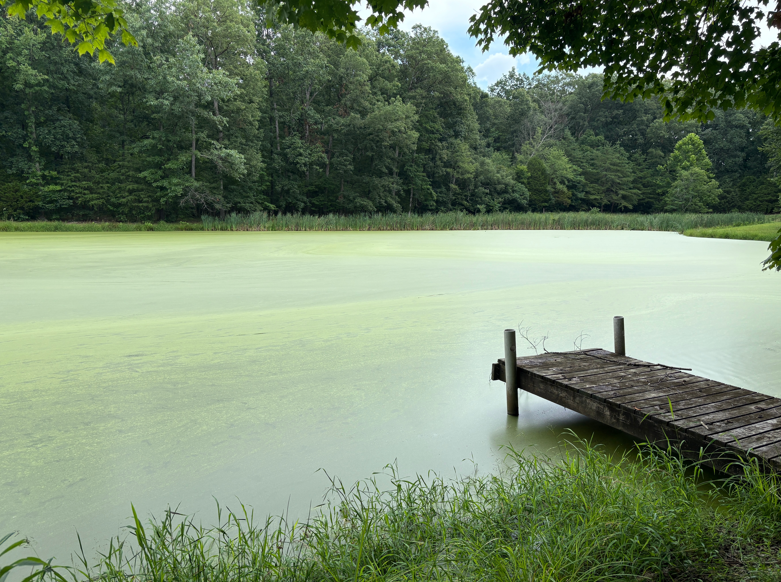
The overgrowth of the bacterium leads to the death of the organism which then floats to the top and forms a “scum” on top of the water. The scum appears blue-green in color but the color of the scum can vary. These “scum” layers can be moved about the pond by wind movement. Sometimes this causes certain areas in the pond to be concentrated with the toxic levels of dead bacterium. Rain or wind disturbance can break up the “scum” and reduce the chance of toxicity, but this is not always the case.
All livestock, pets, wild animals, and humans are susceptible to blue-green algae toxicity. The amount of water consumed needed to cause toxicity depends on the species of animal, concentration of the toxins in the water, and how much water is ingested. Ingestion of 1 quart of highly concentrated water is lethal to cattle.
Most producers do not recognize a problem with blue-green algae until they find dead livestock in the pond or in close proximity to a body of water. Most cattle that ingest contaminated water will die, but occasionally producers may find sick cattle. The clinical signs of blue-green algae toxicity will depend on the type of toxin ingested. The two types of toxins associated with blue-green algae are neurotoxin (affect the nervous system) and hepatotoxin (affect the liver). If seen early, cattle affected by a neurotoxin will show muscle tremors, reluctance to move, and breathing problems. This will lead to convulsions and death. If cattle consume water with liver toxin bacteria, they will have weakness, pale mucous membranes, gastroenteritis, nervous signs, and death. Animals that survive will lose weight and become poor doers. These survivors may also develop photosensitization. Animals with photosensitization are prone to sunburns on light colored skin areas.
Typically, diagnosis is based upon exposure to blue-green algae along with clinical signs or sudden death. If a producer suspects blue-green algae is the cause of death in cattle, he/she should immediately collect a water sample where large amounts of the algae are present. The reason for quickly obtaining a sample is that the toxin could be dispersed by the wind. Then the producer should contact a veterinarian to conduct a necropsy. A necropsy will rule out other causes of death. A veterinarian will most likely take tissue samples for more testing and rumen contents may be taken to examine for presence of blue-green algae. The water sample will need to be submitted for analysis. More information for guidance about necropsy or water sampling may be found at the Oklahoma Animal Disease Diagnostic Laboratory at (405) 744-6623 or view online at https://oaddl.okstate.edu/.
Since there is no known antidote, treatment is usually unrewarding. For this reason, producers need to focus on conditions that favor the development of blue-green algae. Algae bloom in sunny, warm weather. Excessive blooms are associated with ponds located in areas that catch runoff water high in nutrients. Producers should be inspecting ponds anytime these conditions are present. They should be prepared to provide alternative water sources in times of crisis.
Blue-green algae toxicity is not a new problem for Oklahoma livestock. When weather conditions favor algae build up, producers should closely monitor their ponds for signs of blue-green “scum” on the water. If found, producers need to take action to reduce the problem. An excellent fact sheet is available from Oklahoma State University Extension Service on blue-green algae and how to best manage the problem. The fact sheet can be found at https://extension.okstate.edu/fact-sheets/toxic-blue-green-algal-blooms. If a producer has questions about blue-green algae, they should contact their local veterinarian or their Oklahoma State University County Extension Agriculture Educator.
References:
Meehan, M., A., Galbreath, J., and Mostrom, M. (2026). Cyanobacteria (blue-green algae) Poisoning [Fact Sheet]. North Dakota State University Extension.
Morgan SE. Water quality for cattle. Veterinary Clinics of North America Food Animal Practice. 2011;27(2):285
Newcomer B. W. (2022). Toxicologic Insults to the Bovine Liver. The Veterinary clinics of North America. Food animal practice, 38(3), 421–432.
Osweiler, G. D., Carson, T. L., Buck, W. B., Van Gelder, G. A. (1985). Toxic Blue-Green Algae. Clinical and Diagnostic Veterinary Toxicology (3rded) (pp-451-452). Kendall/Hunt.