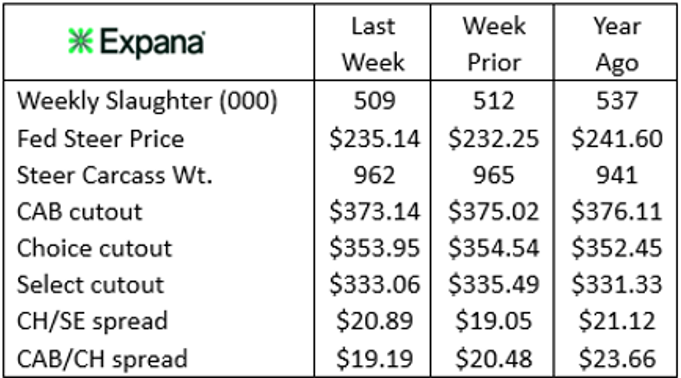
After finding a seasonal bottom at $230/cwt. in late July, the fed cattle market gained further upward momentum last week. The live price average of $235.14/cwt. was $2.89/cwt. higher than the week prior. Similarly, August Live Cattle futures have recovered from their massive routing that took the contract down to $223/cwt. on July 28. Early this week, the August contract was traded at a $2/cwt. discount to last week’s fed cattle average.
Federally inspected cattle harvest was exceptionally low last week with just 509,000 head total, down 3,000 on the week and 28,000 head lower than the same week last year. The week’s year-over-year head count decline was 5.2% compared to the year-to-date deficit of 7.3%. Packers continue to ration cattle harvest throughput to regain margins as boxed beef cutout values stabilize.
Early-week cutout values showed strength as the Choice cutout value has regained $10/cwt. from the summer low reached at the end of July. Quality price spreads are normalized within the seasonally expected ranges, with the traditional Certified Angus Beef ® brand cutout priced at $19/cwt. over USDA Choice and the Choice-Select spread just under $21/cwt., even with a year ago.
The rib primal has been supportive of cutout values as buyers begin filling supplies for Labor Day holiday needs. The expected August price pattern suggests continued strength in cutout values. Wholesale chuck and round prices are steady, with a seasonal increase anticipated for chuck rolls near term.
CAB short loins have been on a fast-track to lower values in an accelerated seasonal price decline, currently pricing 14% lower than a year ago. Similarly, 0x1 strip loins are on a lower price trajectory but at a price now equal to a year ago.
The cutout rally in August 2025 was exceptionally strong, with a much steeper increase than in the two prior years. Although price strength is expected for the remainder of the month, it would be a significant feat for the increase to match August 2025.
Heifers Dip Low in the Harvest Mix
The recovery status in U.S. beef cow numbers in the U.S remains a top-five issue in the beef complex. Hand-over-fist increases in feeder cattle values over the past two years have provided indications that 2026 would bring about the cycle-low in calf head counts. Yet prolonged drought in some of the most important beef cow states has delayed the start of female retention.
To gauge replacement female retention, one of the metrics we often reference is the percentage of heifers in the fed cattle harvest mix. A rule of thumb (with variations depending on source) is that 36% is the equilibrium point. When heifer numbers are greater than 36% of the total harvest, it signals contraction of the nation’s breeding herd. In contrast, when the percentage dips below 36% the signal is that of expansion. Modification to the rule of thumb is a recent theme, whereby changes in dairy reproductive management have allowed for more beef x dairy heifers in the fed cattle harvest, possibly pushing the equilibrium number up by a percentage point or more.
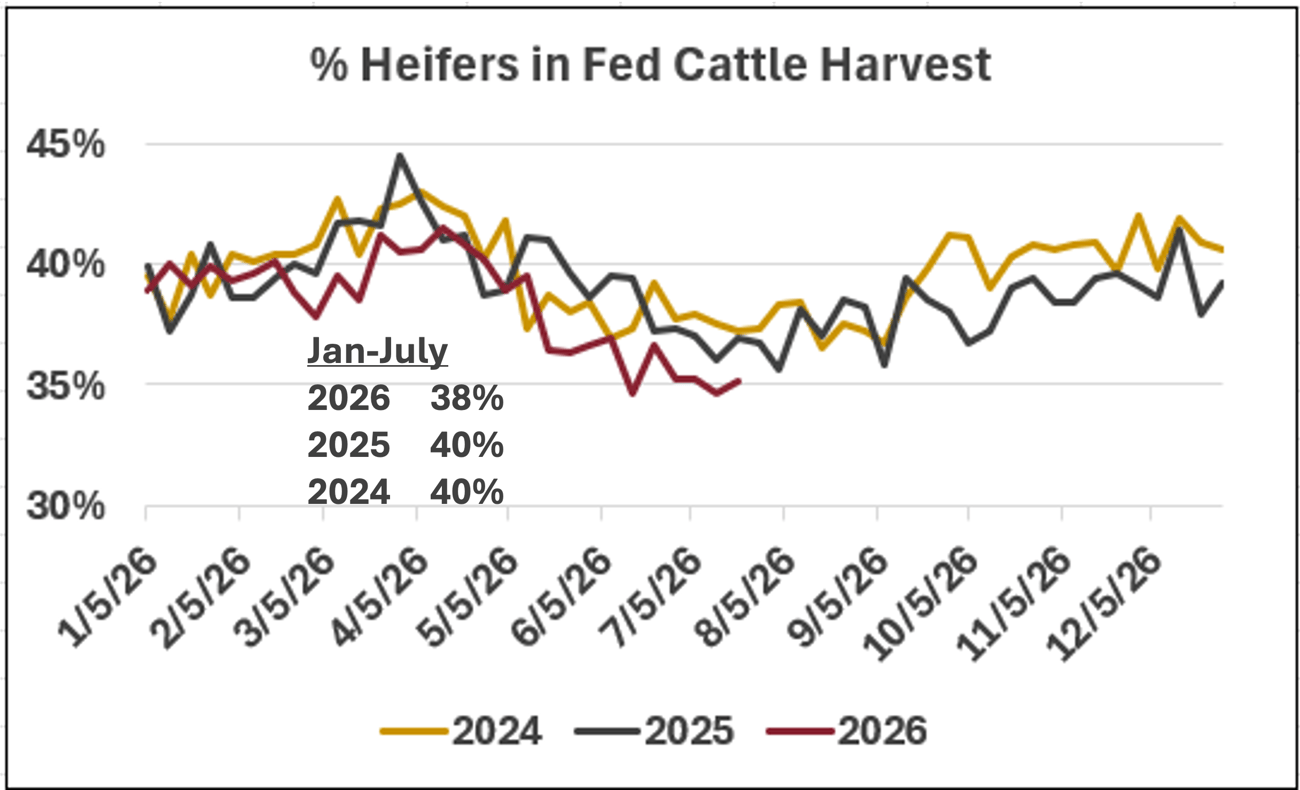
For the latest four weeks ending July 26, recent USDA data shows a downward shift to 35% heifers in the harvest mix. There is a strong seasonal trend for this measure to drop by 2 ppt. in the third quarter. Yet the July 2026 data indicates that the heifer share is 2 ppt. lower than July 2025 and 3 ppt. lower than the 3-year average for the period. Year to date, the heifer portion of fed harvest is averaging 38% versus last year’s 40% average through July. This is a positive indicator pointing toward the beginnings of heifer retention.
The biannual Cattle Inventory report from USDA added credence to these observations as the replacement heifer inventory was measured at 2.7% larger than inventory numbers from a year ago. However, continued drought and especially hot daily temperatures in the western half of the country pose a threat. Reduced hay production and deteriorating grazing conditions will pressure producers in several regions. Earlier weaning and shipping dates for the spring calf crop have been a noted feature of the summer video sales thus far. Reduced heifer retention rates from this year’s calf crop may also be a headwind to herd rebuilding.
Hot carcass weight tonnage in 2026 is calculated at 4.9% lower than a year ago despite an average carcass increase of 31 lb. per head. A portion of the decline in throughput is simply due to negative margins disincentivizing packers from ramping up weekly head counts. Still, the beef sector continues to walk a thin line in terms of feeding and packing capacity utilization. The scheduled return of Mexican feeder cattle imports promises to fill some of the void. This is the primary source of growth in the U.S. fed cattle harvest in store for 2027. Increased female retention shouldn’t begin to show up in greater fed cattle numbers until 2028.