

With calf prices remaining strong, cattle producers have an important decision to make this fall: sell calves at weaning or retain ownership and add more weight. OSU extension specialist Scott Clawson says producers need to look beyond the current price of calves and carefully evaluate the potential value of additional weight, the cost of putting that weight on and the risks involved.
Calf Market Follows a Seasonal Pattern
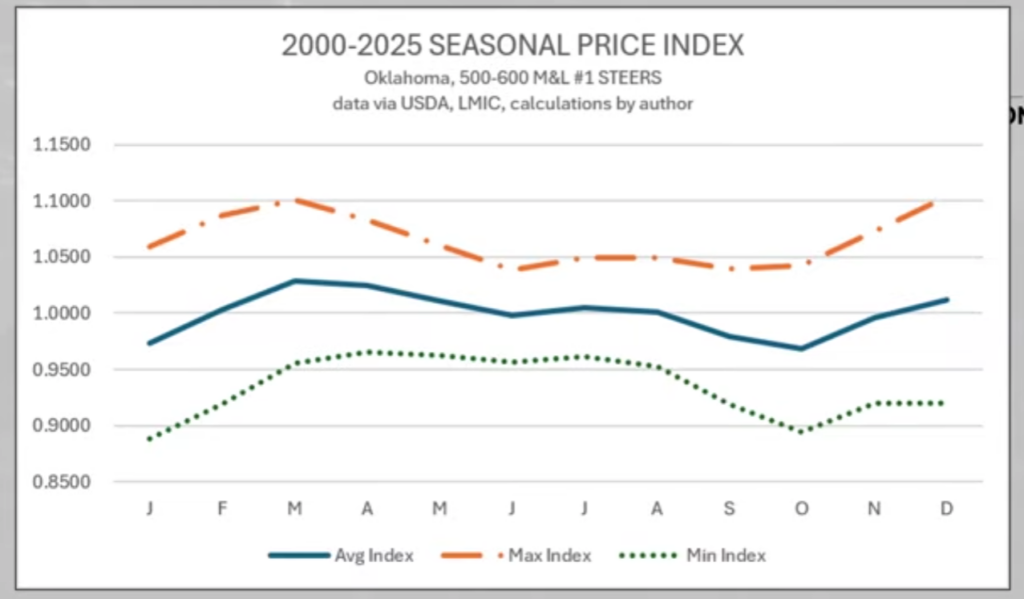
Clawson says the calf market traditionally follows a seasonal pattern, with prices generally strongest in the spring before retreating through the summer and reaching a seasonal low in the fall. “Seasonality is not about high prices or low prices; it’s the variation in price through the year,” Clawson said.
That pattern is largely tied to the fact that most U.S. calves are born in the spring, creating a large supply of calves that are weaned and marketed in the fall. Weather, forage availability and the stress associated with weaning can also make the fall marketing decision more difficult.
Strong Fundamentals Support the Calf Market
While seasonal trends provide useful historical information, Clawson says producers cannot rely on seasonality alone to determine where prices are headed. “Seasonality looks backwards and it doesn’t take into account some of the current things that are happening,” he said.
Clawson said tight cow numbers and a limited beef calf crop remain supportive of calf prices. Low cattle placements and resilient beef demand are also providing support, although changes in feeder cattle supplies and other market news could put pressure on prices.
What Is Another Pound Worth?
For producers considering retaining calves, one of the most important calculations is the value of gain.
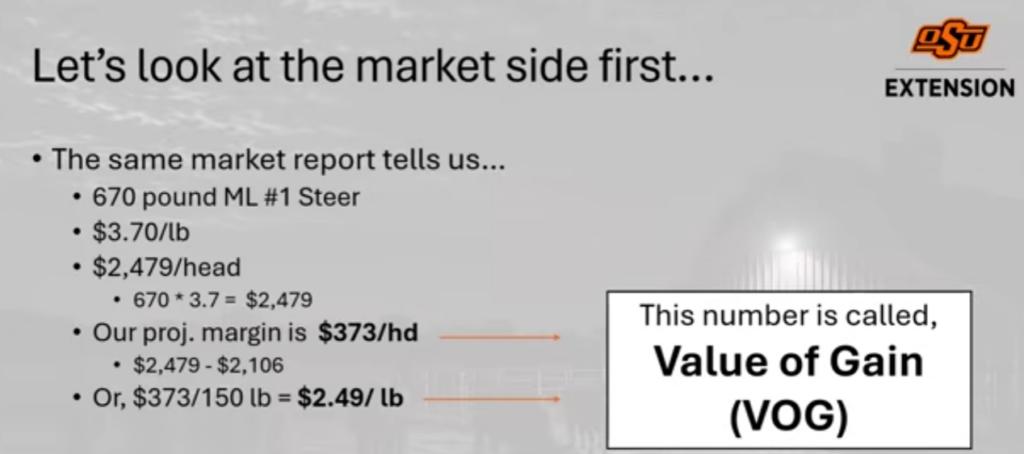
In Clawson’s example, a 520-pound steer was valued at just over $2,100, while a 670-pound steer was valued at just under $2,500. That created a potential margin of about $373, or approximately $2.49 for each additional pound of gain.
But Clawson cautions producers against assuming that every pound added to a calf is worth the same as the calf’s current price. “One of the things that I get really frustrated with is that we automatically assume that if this calf is worth $4 a pound, then every pound that we add is worth $4, and that’s simply not the case,” Clawson said.
He said the value of each additional pound changes as cattle move through different weight classes, making it important to evaluate the relationship between the starting and ending values.
Cost of Gain Completes the Equation
The other side of the decision is determining what it will cost to add those pounds. Using a dry-lot example that included feed, hay, veterinary expenses, miscellaneous costs and an allowance for death loss, Clawson calculated a total cost of about $245.75 per head to add 150 pounds. That resulted in an estimated cost of gain of approximately $1.64 per pound.
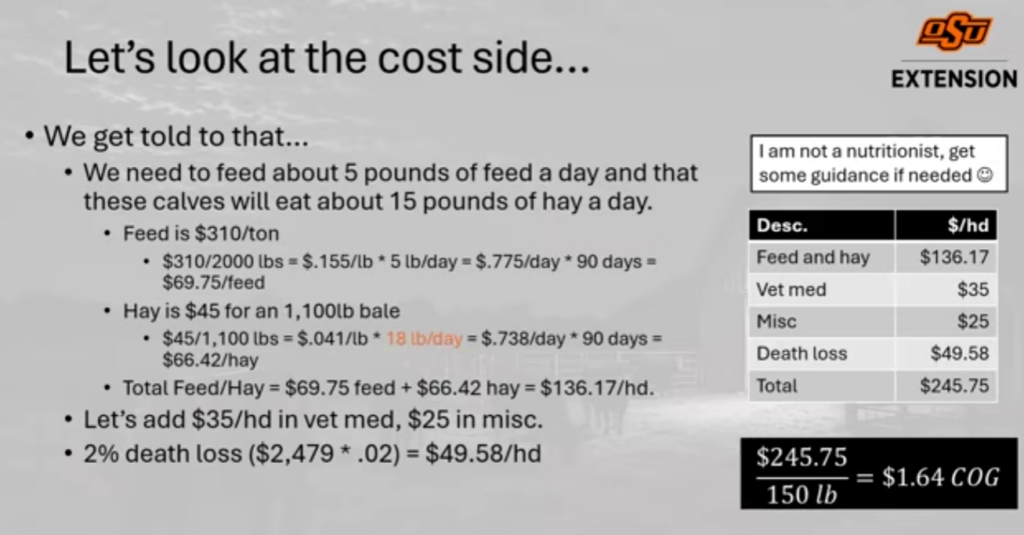
“Generally speaking, if we have a positive relationship there, right, our value of gain is higher than our cost of gain, then we’re making money by feeding and adding weight to those cattle,” he said.
The example produced an estimated additional profit of roughly $77 per head. However, Clawson stressed that individual producers will have different costs depending on their available forage, feed prices, hay supplies and management practices.
Producers Need to Know Their Own Numbers
Clawson says the most important part of the decision is determining what it will actually cost to add weight on a producer’s own operation. “We have to go back to the kitchen table and figure out what is it going to cost for you to add that pound on your place,” Clawson said.
Available grass could lower the cost of gain compared with a completely dry-lot situation, while higher feed, hay or veterinary costs could quickly reduce the potential margin. Producers also need to remember that a current market price does not guarantee what cattle will be worth when they are eventually sold.
Market and Production Risk Matter
Clawson recommends producers evaluate whether the retained-ownership decision still makes sense if the market remains flat rather than assuming prices will increase. “I like to calculate things at a flat market, right? Assuming that nothing is going to be big and disruptive at this point, either positive or negative,” he said.
Production risk also needs to be considered. If cattle fail to reach the expected average daily gain or experience higher-than-expected death loss, the break-even price can increase substantially. In Clawson’s example, an expected average daily gain of 1.66 pounds per day was used. If gains fell to 1.3 pounds per day, the break-even price would increase to about $3.69 per pound.
Price Protection and Tax Considerations
Producers who retain calves also have options for managing price risk. Clawson said Livestock Risk Protection, or LRP, can provide a price floor, although the cost of the insurance needs to be included in the overall calculation.
Tax implications can also play a role. Moving calf sales from the end of one year into the beginning of the next could reduce current-year revenue, but producers need to consider how that could affect the following year’s tax situation.
“If your normal business is to sell calves every fall in October and November, just beware that if you were to push this year till after the first of the year, that puts you in a position next year where you’re likely to have a lot of revenue to deal with and only one year of expenses,” Clawson said.
Sell or Retain? Know the Break-Even
Ultimately, Clawson says there is no single answer for every operation. Producers need to determine whether the potential value of additional gain exceeds the cost of producing that gain while also accounting for market, production, management and tax risks. “When we move past that, we become a margin business, and so we’re looking at price spreads, not necessarily overall value,” Clawson said.
For producers considering retaining calves, the key is to establish the starting value, expected ending value, cost of gain and break-even point before making the decision. Clawson also encouraged producers to seek help from local Extension personnel, who can connect them with nutritionists, agronomists and economists to evaluate the decision based on the specific resources and costs of their operation.
To follow along and view all of the graphs, watch the full video below