

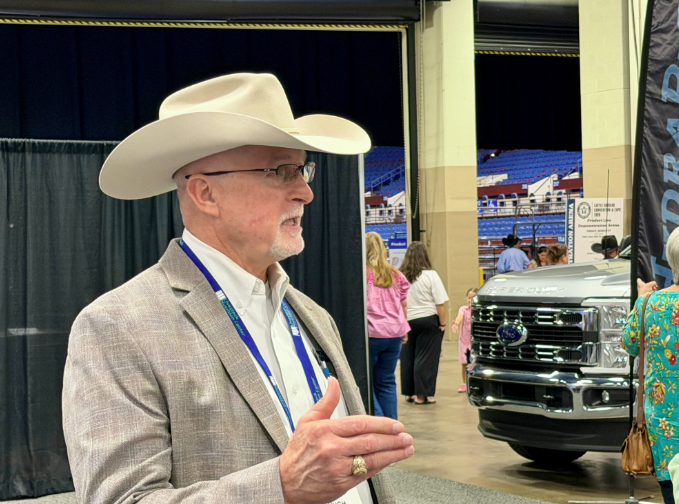
In today’s Beef Buzz, senior farm and ranch broadcaster Ron Hays speaks with Hugh Aljoe, who says the Noble Research Institute has sharpened its mission around helping farmers and ranchers improve grazing land resiliency and ranch profitability.
Noble’s New Focus: Land Health and Profitability
Aljoe said Noble has shifted its efforts to deliver measurable results for producers, especially those managing grazing land. “We’ve changed our focus to where we’re going to center our efforts around results for the farmers and ranchers,” Aljoe said. “So that they can have land that becomes more resilient… but also on profitability as well.”
He said the goal is twofold: improve the land resource while also strengthening the producer’s bottom line.
Stocking Rate Is the Key Management Tool
With drought concerns lingering across the Southern Plains, Aljoe said Noble teaches producers to closely monitor forage production and adjust cattle numbers accordingly. “We estimate forage production across the entire operation every month,” he said. “If we see that things are trending differently… then we start adjusting our stocking rate.”
When forage supplies were abundant this winter, Noble added cattle. As conditions trend drier, those extra animals may be removed to keep stocking rates within carrying capacity. “Stocking rate’s the real key,” Aljoe said. “Part of that stocking rate is knowing what your carrying capacity is.”
He added that carrying capacity changes every year and every season, making regular monitoring essential.
Cutting Feed Costs Through Grazing Management
Aljoe also discussed Noble’s decision to greatly reduce hay feeding on its southern Oklahoma ranches by grazing year-round and carefully allocating forage. “We figure we can graze year round,” he said. “Some of the big expenses we had were hay and feed.”
Instead of feeding stored hay through winter, Noble stockpiles grass during the growing season and portions out one to two days of grazing at a time. He compared it to feedyard ration management. Aljoe said lowering feed costs has significantly improved profitability. “If we look at what cattle producers averaged… about $900 to $950, well ours is closer to double that,” he said.
National Reach Through Regenerative Ranching
Aljoe said Noble has expanded far beyond its earlier local service area and now seeks national impact through education centered on regenerative ranching principles. “We’re going out to all parts of the country,” he said. “Working with nature more and making sure we’re planning for the profit.”
He noted that while principles apply broadly, specific practices must be adapted regionally through partnerships with local organizations. Aljoe said the ultimate goal is to help ranchers build resilience in both their land and their business so operations can be passed to the next generation.
The Beef Buzz is a regular feature heard on radio stations around the region on the Radio Oklahoma Ag Network and is a regular audio feature found on this website as well. Click on the LISTEN BAR above for today’s show and check out our archives for older Beef Buzz shows covering the gamut of the beef cattle industry today.







