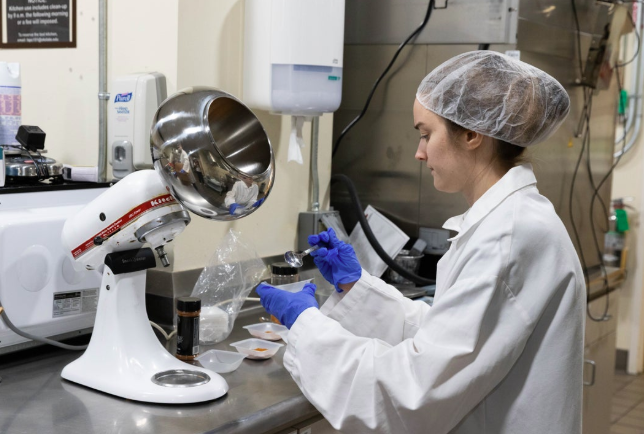
When someone says engineering, most people likely envision someone who designs machinery or buildings, but graduating engineers also step into a wide variety of careers, from food and agriculture, healthcare and manufacturing to technology, research, design, operations and management.
Oklahoma State University Department of Biosystems and Agricultural Engineering seniors demonstrated this diversity Friday during the annual Senior Design event, in which graduating seniors demonstrate their research projects for OSU faculty and staff, stakeholders and the general public.
“This is always a proud moment in the academic year,” said Mari Chinn, biosystems and agricultural engineering department head. “Senior projects challenge our students to draw from their years of coursework, think critically, navigate team and interpersonal relationship dynamics, develop confidence with their skills and realize their potential in a safe space before they embrace the next steps in their career.”
Most of the team projects not only gave students experience in research and design but also in working with industry partners.
“It’s challenging but valuable,” said senior Sarah Spring, who was part of the Cashew Crew design team. “You’re balancing rigorous academic work with a sponsor who may not yet know what criteria they need. You often have to work with them through that process.”
“A big part is learning how to communicate engineering concepts to people without engineering backgrounds,” added teammate Eric Renner.
Payden Ferguson, owner of Padiano’s Kitchen of Broken Arrow, is an OSU alumnus with a working relationship with OSU’s Food and Agriculture Products Center and the team’s sponsor. He approached the university for help with upscaling his cashew production. Padiano’s has become popular for its Crackshews (roasted, seasoned cashews), but the business struggles to keep up with growing demand with its current technology.
“It’s very similar to real-world engineering – open-ended problems, shifting expectations and finding a solution everyone can agree on within time constraints,” said Cashew Crew team member Eli Reynolds.
“Initially, we focused on roasting and coating processes to identify equipment that could scale up production,” Spring said. “After a site visit, we noticed quality defects and decided to investigate ingredient replacements, specifically binding agents.
At the end of the fall 2025 semester, after working under the supervision of faculty advisor Tim Bowser, the team presented recommendations on binding agents and equipment options to Ferguson, proposing full-scale solutions, such as machines that will both roast and coat cashews at a faster rate, and more budget-friendly, partial-scale solutions, such as machines that roast at a faster rate with separate machinery for coating. The Cashew Crew won the Top Biosystems Engineering Presentation award at Friday’s event.
Following graduation, Spring will be working for an ingredients and flavor consulting company headquartered in Beloit, Wisconsin, while Reynolds pursues medical school. Renner will work on optimizing dry goods storage and process flow for Calvin Foods in Siloam Springs, Arkansas.
The following are other projects highlighted at the Senior Design event on Friday:
Team name: DJR Implements
Team members: Harrison Frazier, Doug Harshbarger and Jacksen Ketner
Industry sponsor: LL Implements
Faculty advisor: John Long
Research: Customized hopper and seed metering system for a variable no‑till drill
Small-scale farmers using walk-behind tractors often lack access to affordable precision planting equipment that can handle a wide range of seed sizes. Existing commercial systems are typically designed for larger tractors, making them cost-prohibitive and incompatible with compact no-till drills. The DJR Implements team worked on designing a hopper and seed metering system that can be easily mounted on LL Implements’, an Oklahoma-based agricultural equipment company, prototype no-till drill, which is compatible with walk-behind two-wheel tractors. Fluted roller and seed plate designs were developed and tested to evaluate performance in planting a wide variety of seed types.
Team name: Erosion Erasers
Team members: Kami Blythe, Jaycee Greening, Tatumn Kennedy and Eli Wood
Sponsors and faculty advisors: Ali Mirchi and Sara Alian
Research: Stillwater Creek streambank stabilization
This project addressed streambank instability along Stillwater Creek in Stillwater, with a focus on severe erosion near the Country Club Road bridge crossing. The Erosion Erasers team surveyed the project site and combined this information with satellite data to generate accurate elevations and geometry. The processed geometry was put into the Hydrologic Engineering Center’s River Analysis System (HEC-RAS) for hydrologic modeling. The model was used to analyze flow depth, velocity, shear stress and the potential transportation of sediment. Shear stress is a force that causes parts of a material to slide past each other in opposite directions (sliding a deck of cards or using scissors to cut paper). This provided a practical approach for evaluating options for streambank stability. Educational outreach was developed to communicate the proposed restoration strategies to the community.
Team name: The Hedge Fund
Team members: Garrison Green, Brady Holzapfel and Cara McWilliams
Industry sponsor: Jim Curl
Faculty advisor: Tim Bowser
Research: Pneumatic press to evaluate hedge apple processing
The hedge apple (Maclura pomifera) is a widely distributed but underused fruit native to the south-central United States. It contains bioactive compounds, such as pomiferin and osajin, with antioxidant and antimicrobial properties with potential applications in human and veterinary topical treatments. Despite its promising chemical profile, commercial use remains limited due to insufficient processing data and the lack of standardized extraction methods that can preserve the bioactive compounds while producing consistent juice yields.
This project focused on the design, fabrication and evaluation of a small-scale pneumatic pressing system to support continued testing of hedge apple material properties and juice extraction performance. The pneumatic press is designed to provide controlled and repeatable compressive forces, enabling evaluation of pressure, time and yield efficiency.
Team name: Sustainalight
Team members: Jayden Barbere, Kylie Daum, Dulce Gallardo-Owens and Gillian Queller
Sponsor: OSU Office of Sustainability and OSU Facilities Management
Faculty advisor: Scott Frazier
Research: Sustainable lighting solution
Construction of the Central Marketplace at Oklahoma State University created lighting challenges in areas adjacent to the construction site. When on-grid power was removed from the area to allow for safe deconstruction of pre-existing infrastructure and construction of a new building, the area became extremely underlit. This case prompted consideration of other low-lit areas on the OSU campus. Insufficiently illuminated areas on campus pose potential safety concerns for students, staff and faculty. OSU Facilities Management and the Office of Sustainability partnered with the team to investigate methods to resolve areas of insufficient lighting on campus using renewable energy. A solar-based solution was designed, prototyped and tested to assess lighting intensity, coverage area and duration under a wide range of conditions.
In addition to engineering design projects, the Department of Biosystems and Agricultural Engineering also provides real-world experiences to its Agricultural Systems Technology students through its senior capstone course. The following projects will be showcased this week, highlighting the program’s goal of implementing existing technology to advance agriculture and food production operations and practices:
Team name: Autodrone
Team members: Derek DeGroot, Chloe Stafford, Hercules Gonsalves and Nick Stratman
Sponsor: Dr. John Long’s Precision Ag Extension Program
Faculty advisor: John Long
Research: Multiple drone management
The Autodrone team worked with drones to maximize efficiency in the agriculture industry by enabling multiple drones to autonomously complete any given task. This will help the producer save time to allocate to other jobs.
Team name: FarmSim
Team members: Luke Ackerley, Ben Ridder and Mason Harris
Sponsor: Dr. John Long’s Precision Ag Extension Program
Faculty advisor: John Long
Research: Yield monitor simulation
The FarmSim team worked on developing a live yield-monitoring simulator with the goal of creating a college-level classroom demonstration of how live yield monitoring technology works and demonstrating concepts like yield mapping, GPS data collection/calibration and field variability.
OSU Ag Research is Oklahoma’s premier research and technology development agency in agriculture, natural resources and the life sciences.