
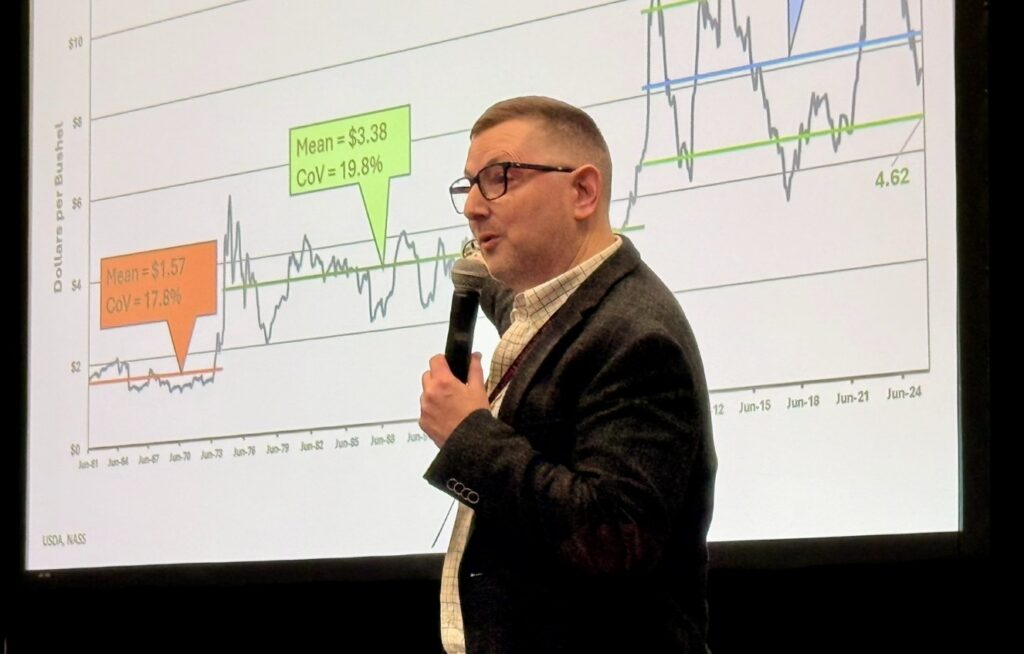
The hard red winter wheat markets are currently experiencing significant volatility, driven by geopolitical conflicts and challenging weather conditions across the Plains. In a recent discussion with Farm Director KC Sheperd, Oklahoma State University’s Todd Hubbs highlighted the rapid price swings, noting that the July contract for Hard Red Winter Wheat (HRW) recently climbed above $7.00, peaking near $7.18 before retreating toward $6.91. Hubbs emphasized that this instability is likely to persist as the market reacts to shifting crop projections and global tensions.
Wheat Crop Conditions and Heading
The impact of ongoing drought is becoming increasingly visible in USDA condition reports for key growing states like Kansas, Oklahoma, and Texas. Hubbs noted that the wheat crop is developing rapidly, with a significant portion already heading.
“We’ve seen wheat heading… it’s accelerated. It really looks like we’re a couple weeks ahead here in Oklahoma… and that has implications for yield, size, and general quality.”
In Oklahoma, approximately 43% of the wheat crop is already considered headed. While some areas north and east of I-35 show decent potential, conditions remain spotty and generally worsen further west. Hubbs expressed concern that despite the recent price rallies, a serious loss in yield is expected across most HRW producing states.
Corn and Soybeans Outlook
Unlike the wheat market, corn and soybeans have remained relatively stable. The U.S. continues to move corn at a high volume, maintaining its position as a provider of the world’s cheapest corn despite high energy and transportation costs.
- Export Strength: Hubbs anticipates the USDA may raise export numbers again due to strong global demand.
- Weather Premium: A serious weather premium has not yet been built into December corn prices, though uncertainty remains regarding the “Super El Niño” patterns discussed earlier in the year.
- Acreage Uncertainty: The market is still waiting for clearer data on total planted acres and initial yield estimates.
The E15 Debate and Consumer Demand
The conversation also turned to the potential impact of E15 (15% ethanol blend) legislation. While lawmakers on Capitol Hill suggest this could be a major win for corn producers, Hubbs offered a more cautious perspective, noting that the bill allows for the blend but does not mandate it.
“E15’s a nice idea; people have to buy it. It’s not mandated… I don’t see us like rocketing up in consumption of E15 even if this goes through.”
Hubbs pointed out that significant infrastructure investment would be required for service stations to expand E15 offerings. Furthermore, consumer preference remains a hurdle, particularly in states like Oklahoma where E0 (ethanol-free gas) remains popular.
Market Strategy for Producers
With volatility “off the charts,” Hubbs advises producers to be prepared to act when prices hit profitable levels. He noted that while there may be room for prices to run depending on how the crop finishes, timing the absolute top of the market is nearly impossible.
“If you get these rallies above seven and you think, ‘Okay, I could sell it… you’ve got to have that bid in there to let it click over and sell it. I think in these prices, you probably won’t regret selling your crop.”
Producers are encouraged to stay mindful of upcoming trade policy milestones, such as the USMCA review scheduled for July, which could introduce further uncertainty into the markets.