

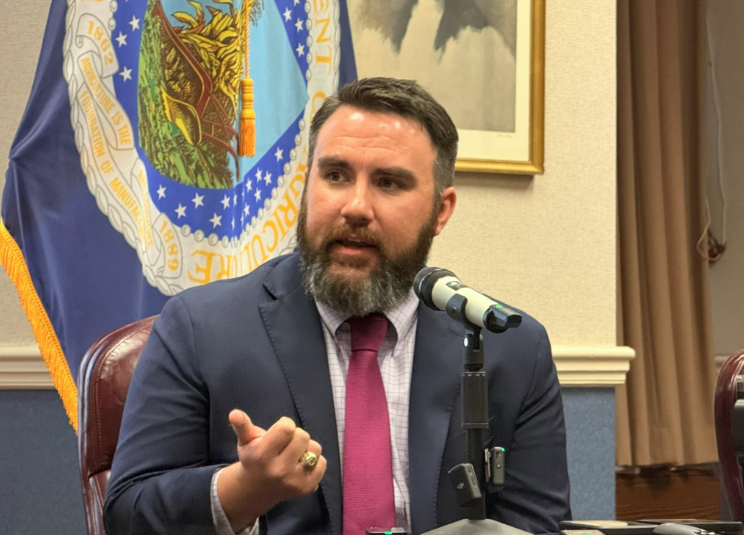
In today’s Beef Buzz, senior farm and ranch broadcaster Ron Hays features comments from Justin Benavidez, who joined Farm broadcasters from across the country and stakeholders at the National Farm Broadcasters Washington Watch to break down cattle market dynamics, herd rebuilding signals, and broader economic pressures shaping the industry.
Early Signals of Herd Rebuilding Emerge
Benavidez says the cattle cycle remains a reliable guidepost, even as producers debate what’s really happening on the ground. “The cattle profitability is all based on the cycle… looking back over over 100 years, the U.S. cattle cycle is a very well-documented phenomenon.”
While opinions vary widely, he points to gradual trends in the data as the clearest indicator. “What the data is telling us in that pattern over time is that we’re seeing the earliest indicators of a herd rebuild… a slight retention in heifer uptick year over year.”
Even so, he acknowledges uncertainty remains. “I hear people… very passionate on both sides of we’re not retaining heifers, or we are retaining heifers, and USDA data… is not telling the full story.” Even so, he says those year-over-year trends still offer the best directional signal for where the industry is headed.
Prices, Feed Costs, and the Turning Point
Strong cattle prices are beginning to encourage expansion—but weather and forage availability could complicate progress. “I think we’re at the point where prices are motivating a rebuild. Some of those weather concerns, lack of forage, are going to make it a little bit questionable.”
Looking ahead, Benavidez expects a gradual shift in the market. “We will probably see more heifers retained… that does not mean an immediate overnight loss in price, but I think we’ll begin that gradual turn… lower prices, higher inventories year over year.”
He also emphasized the role of feed costs, noting favorable conditions for livestock producers. “As long as we don’t have… major weather issues… we’re going to continue to have burdensome stocks… [which means] cheap feed for our livestock.”
Consumer Behavior and Country of Origin Labeling
On the issue of labeling, Benavidez says consumer behavior ultimately comes down to price. “The data historically has told us that consumers are price sensitive.”
Even when preferences are clear, price often wins out. “If they have to pay more for it, that price usually pushes them back into a cheaper product.”
Still, he says voluntary labeling efforts could provide valuable insights moving forward. “It’ll be interesting to see what this new sort of experiment… tells us in terms of the data we collect after the fact.”
Packing Capacity Concerns and Market Volatility
Benavidez also addressed ongoing concerns about packing plant capacity, especially following recent closures and slowdowns. “The cattle cycle is very gradual… but losing a plant is a very binary outcome.”
That imbalance can create ripple effects across the supply chain. “A packer is pricing and covering their cost on hooks filled… not necessarily the weight sold.” He expressed particular concern for smaller, regional operations. “I do worry about some of our mids and our regionals if they don’t have enough throughput.”
Over time, those disruptions can amplify volatility in the cattle market. “It becomes a vicious liquidation cycle of hook space… that really creates a lot more volatility… and that’s why we see… price swings that are so drastic on both sides of the cycle.”
From herd rebuilding signals to structural challenges in processing, Benavidez says the cattle industry is approaching a turning point—one that could gradually reshape supply, prices, and profitability in the years ahead.
The Beef Buzz is a regular feature heard on radio stations around the region on the Radio Oklahoma Ag Network and is a regular audio feature found on this website as well. Click on the LISTEN BAR above for today’s show and check out our archives for older Beef Buzz shows covering the gamut of the beef cattle industry today.







