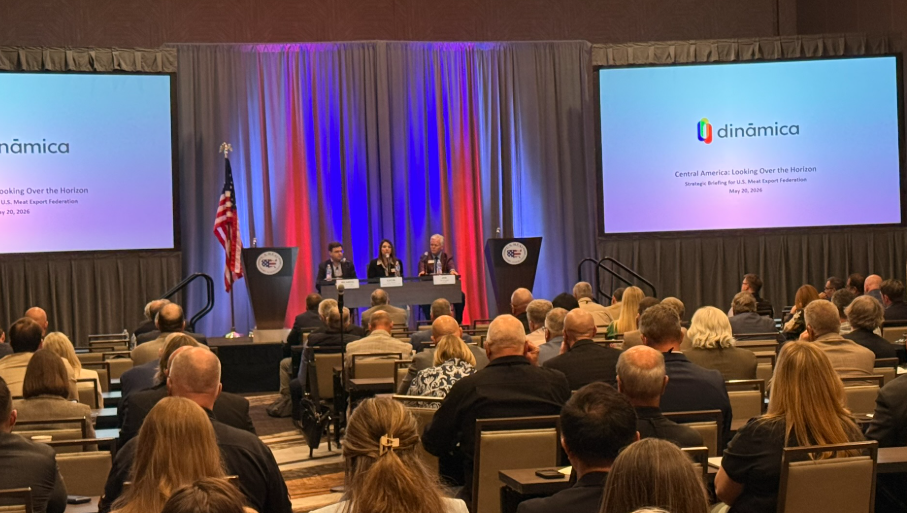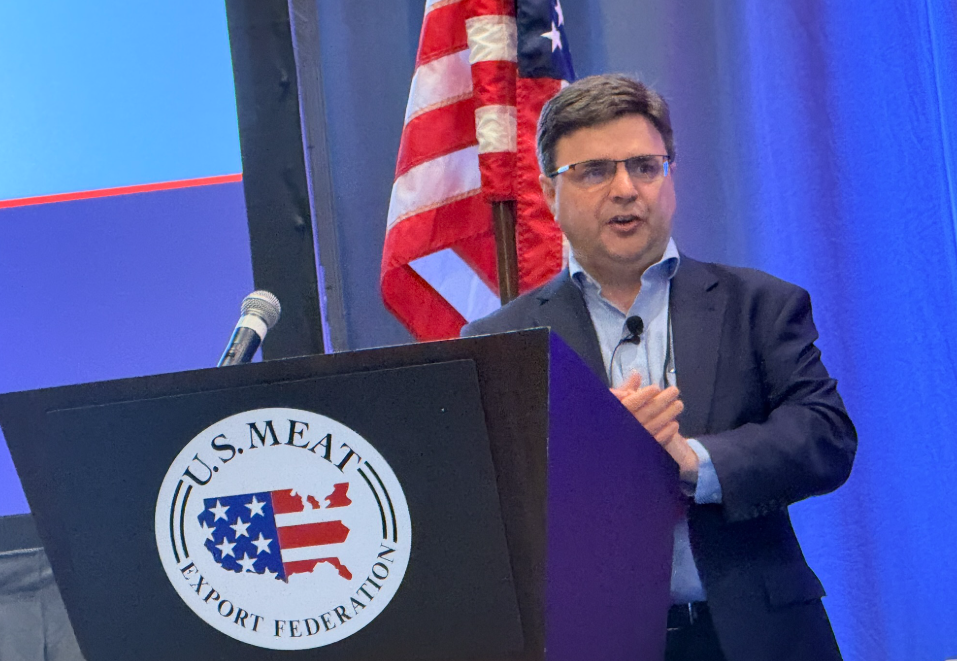
The United States Meat Export Federation (USMEF) Spring Conference in Oklahoma City highlighted the rapid growth and underlying political realities of the Central American market for American beef and pork. As global demand rises, agricultural experts and foreign policy professionals are analyzing how deep-rooted trade agreements like the Dominican Republic-Central America-United States Free Trade Agreement (CAFTA-DR) provide essential market access, while emphasizing that ensuring stable U.S. meat exports through trade certainty requires actively navigating regional shifts and geopolitical friction.
The panel was hosted by USMEF Vice President of Communications Joe Schuele and featured Ricardo Zúñiga, founding partner of Dinámica Americas and a 30-year veteran of the U.S. Senior Foreign Service, as well as USMEF Central America Representative Lucía Ruano.
A Powerful Commercial Success Story
Opening the session, Joe Schuele detailed the immense commercial scale the region has achieved, projecting it to become a billion-dollar destination in the near future.
“We’ve had this fabulous growth in Central America,” Schuele said. “It’s just developed into a tremendous market. About 800 million in business last year, 600 million on the pork side, about 200 million on the beef side. So we’re on a trajectory in the not-too-distant future for Central America to be a billion-dollar market”.
Ricardo Zúñiga, who served for three years as the principal White House advisor for the Americas on the National Security Council, emphasized that this economic boom is structurally deep and culturally aligned with the United States.
“Central America is 50 million people. That’s bigger than any U.S. state,” Zúñiga noted. “The combined GDP of the CAFTA-DR countries is $425 billion. And what’s important about it is a lot of that GDP is connected to the United States”.
Zúñiga outlined five structural drivers behind this growth:
- Rising Incomes: Moving along paths similar to other emerging markets.
- Rapid Urbanization: The region is now 70% urban, reversing the 1970s’ 70% rural reality. Urban environments radically transform diets by opening up access to refrigeration, cold chains, and supermarkets.
- Remittances: Money sent by family members working in the U.S. significantly increases disposable income.
- Tourism and Services: Expanding strongly across countries like Guatemala, Honduras, and El Salvador.
- Sophisticated Retail Infrastructure: Heavy investment in modern cold chains by major retailers such as Walmart, PriceSmart, and local supermarkets has established high-quality food delivery mechanisms.
The Critical Role of Remittances
A massive driver of cash directly impacting food purchases and protein demand is the steady flow of remittances from workers living in the United States back to their families in Central America.
“Money sent from abroad raises disposable income significantly, more than almost anything else,” Zúñiga explained. “For many families, it’s the single largest source of income, of disposable income, and that goes right into the diets, right into the food purchases of families”.
Providing concrete figures, Zúñiga noted that in Guatemala, remittances account for approximately 20% of the country’s GDP, totaling $21 billion annually. In Honduras, reliance is even greater, accounting for 25% of total GDP. “That’s the story in terms of disposable income. That’s it,” he said. “So it’s, for many families, the single largest source of income”.
Evolving Consumer Perceptions of U.S. Pork
USMEF Central America Representative Lucía Ruano explained how targeted marketing and structural demand-chain education are changing the foundational perception of pork among regional consumers.
“I think that the biggest shift that we are looking at in Central America is the perception that consumers are having about pork,” Ruano stated. “We are teaching them to know U.S. pork as a high-end, quality protein. We are building this culture of people to consume protein as part of their daily diet”.
Historically, local conversations about pork revolved strictly around low prices or its use as a raw ingredient for regionally processed items. Today, international consumer priorities are far more sophisticated.
“Now that conversation has changed,” Ruano remarked. “Now consumers, especially, are asking if that protein will fit in their daily lifestyle, if it’s a protein that helps or supports their health growth, and how they can use the U.S. pork cuts in new ways or different ways based on their daily meals”.
Ruano highlighted USMEF’s comprehensive strategy across the entire value chain, educating food service professionals and retailers, creating tailored digital content, and developing experiential wellness and fitness programs. They are also showing modern consumers how to prepare U.S. pork cuts using modern kitchen appliances such as the Instant Pot, air fryers, and smart, multifunctional systems like the Thermomix.
“At the end, I think that the demand is not the result of just one campaign or specific program or chain,” Ruano said. “It’s the result of creating multifunctional touchpoints that are moving the consumer from awareness, to trial, to menu integration, and adopting a long-term consumption lifestyle of the protein”.
CAFTA-DR Survives Political Challenges
While market demand remains strong, the geopolitical background has required careful management. Schuele brought up what he termed the “CAFTA eviction notice,” referring to past political moves to reconsider or strip trade benefits from nations that act as geopolitical adversaries to the U.S., specifically Nicaragua. Nicaragua remains an autocratic regime with a strong Chinese and Russian presence, yet it remains a beneficiary of CAFTA-DR.
Zúñiga revealed how close the trade agreement came to being upended and credited private-sector voices for protecting the framework.
“CAFTA survived a really tough year,” Zúñiga reported. “It wasn’t going to make it. When you talked to people in the administration, the first order of business of the Latin America team at the White House when Trump came to office was to put Nicaragua on the list for removal from CAFTA”.
The plan was not to dissolve the entire regional pact, but rather to establish distinct conditions that effectively excluded Nicaragua while allowing other cooperative nations to remain. However, the intricate supply chains linking the region to U.S. commerce prompted rapid pushback.
“At the very last second, the U.S. textile industry weighed in, calling the White House… to make the point of how damaging that was going to be for the U.S. textile industry and for U.S. retailers,” Zúñiga revealed. “And that changed the picture overnight… in a period of 48 hours, because of a couple of calls from major U.S. retailers. So there are your allies in keeping CAFTA alive and kicking”.
Looking Around the Corner: Regional Risks
Analyzing the next 24 months, Zúñiga pointed out key risk indicators that agricultural exporters must watch closely, including local political shifts, trade policy updates, and external international conflicts.
While individual country dynamics vary—ranging from Guatemala’s economically robust private sector to the fluid political realities of Honduras and El Salvador—broader macro issues pose the greatest challenges.
The ongoing conflict involving Iran has pushed crude oil prices to volatile highs, which creates immediate problems for Central American states. “Central America is not an oil producer… they pay market rates,” Zúñiga noted. High energy costs quickly drain the limited fiscal space regional governments have to subsidize fuel and support consumer purchasing power.
Furthermore, rising global fertilizer and diesel costs put pressure on both U.S. production and Central American agricultural sectors like sugar and coffee.
Ultimately, Zúñiga identified the U.S. economy’s overall health as the single most important factor in the region’s near-term stability.
“U.S. recession risk is probably the single biggest iceberg for Central American economies. Not Iran, not remittances, not deportation numbers, and now, thank God, not CAFTA,” Zúñiga concluded. “A recession in the United States… that has real impact. You can almost track historically how those numbers go up and down, and they track very closely to the United States”.
The Path Forward
Despite the global and regional hurdles, the panel’s overriding message was that Central America remains a remarkably resilient, high-value, and reliable partner for U.S. agriculture. Exporters are strongly encouraged to actively utilize formal feedback channels with the Office of the United States Trade Representative (USTR) to address technical barriers, protect market access, and continue expanding the bilateral trade relationship.