

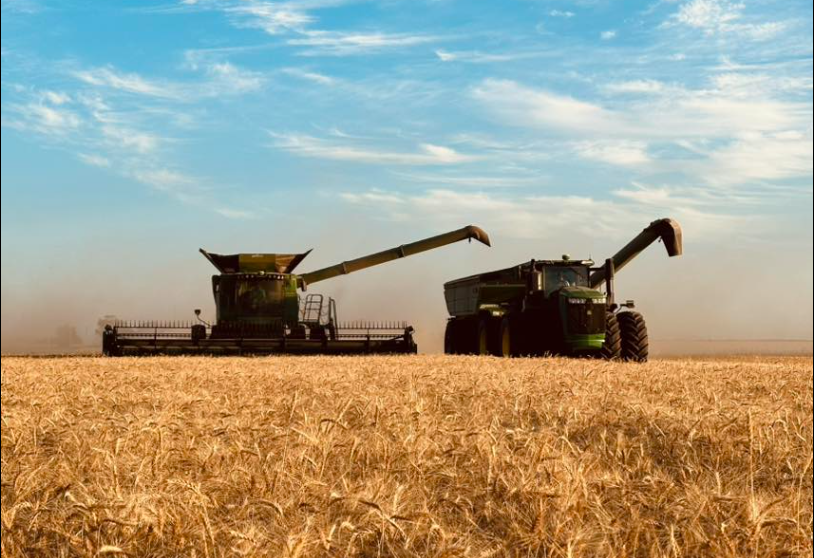
The Oklahoma wheat harvest is officially underway, but the results rolling across the scales are telling two entirely different stories. According to the latest field data from the Oklahoma Wheat Commission, the statewide harvest is approximately 35 percent complete, moving much faster than the recent weekly snapshot from the USDA National Agricultural Statistics Service (NASS), which put progress at 8 percent.
A Brutal Spring Limits Bumper Crop Potential
For producers in the fields, the impact of an unusual spring is glaringly apparent. A severe lack of rainfall in March, paired with a few days of temperatures soaring near 100 degrees, accelerated crop development and forced the wheat to put out heads early.
Pete Mat of Mat Farms near Billings, Oklahoma, noted that the unusual weather patterns severely hurt the crop. He pointed out that there are far fewer heads in the fields than normal. When you can see the bunny rabbits running down the wheat rows, Mat said, it is simply not a bumper crop. Mat shared that while he expects some of his unbooked tickets to potentially reach around 50 bushels per acre, the wheat currently being cut is making in the 20s, with yields scattered everywhere in between.
Harvest Delays and Mixed Yield Reports
While combines are rolling, recent weather patterns have created a localized standstill. Producers in northern and northeastern Oklahoma are struggling to get equipment into the fields due to rain. Similar off-and-on delays impacted southwestern portions of the state over the past week. In northwest Oklahoma, heavy downpours delivered up to 5 inches of rain in a 48-hour window, forcing a temporary halt to harvest operations.
Where cutting has occurred, test weights are holding steady, averaging 58 to 59 pounds statewide. However, yield distributions vary drastically by region:
- Southern and Central Oklahoma: Most reported yields are running low, averaging between 15 to 25 bushels per acre.
- North of Highway 51: Early cut wheat is showing stronger potential, with yields ranging from the mid-30s to the mid-50s.
Drought Conditions and Subsoil Moisture Depletion
The uneven crop performance directly reflects the ongoing moisture deficit across the state. The latest U.S. Drought Monitor indicates that 81 percent of Oklahoma remains in drought status. A detailed breakdown reveals the severity:
- 18% Abnormally Dry
- 34% Moderate Drought
- 10% Severe Drought
- 33% Extreme Drought
- 4% Exceptional Drought
Western Oklahoma and the Panhandle continue to carry the worst of these conditions. According to the June 1st Oklahoma Mesonet update, the month of May finished 1.6 inches below normal for statewide rainfall. Portions of west-central Oklahoma received less than 25 percent of their normal monthly precipitation. May temperatures averaged 69.4 degrees statewide—one degree above normal—ranging from a high of 107 degrees in Erick to a low of 30 degrees in Kenton.
While recent showers have perked up the 2-inch soil moisture layer, the 4-inch plant-available water levels are more concerning. Out west, this deeper subsoil cushion remains incredibly thin, meaning many fields lack the moisture reserves needed underneath to sustain a strong finish.
The official USDA NASS crop progress report released June 1st confirms the heavy toll on the crop, rating Oklahoma winter wheat at 100 percent headed with overall conditions classified as:
- 20% Very Poor
- 33% Poor
- 34% Fair
- 12% Good
- 2% Excellent
Collectively, 53 percent of the crop is rated poor to very poor, compared to just 13 percent rated good to excellent.
Global Market Factors Pressuring Local Prices
On the marketing side, producers are facing a shifting price landscape. Dr. Todd Hubs, Oklahoma State University Extension Grain Marketing Specialist, noted that the USDA projected the hard red winter wheat crop at 515 million bushels in its May Crop Production report. If realized, that total would mark the lowest production level since 1957. Driven by lower acreage and a projected Oklahoma state average yield of 28 bushels per acre, local market availability is exceptionally tight.
Following the release of that federal data in May, the July contract briefly touched $7.50 a bushel. Given local basis points, that peak brought Oklahoma cash prices into the $6.90 to $7.00 range. However, prices have since retreated to around $6.50 per bushel.
Despite the short domestic crop, global supplies are keeping a lid on the market. While parts of the European Union, Poland, and the Baltic states have faced rough patches, overall crops in the EU, Russia, and Ukraine are looking acceptable. Australia’s acreage is down ahead of a potential El Niño event, but that crop will not enter the market until this fall.
The primary pressure on global prices stems from unexpectedly strong wheat crops in North America, Argentina, and specifically major importing regions like North Africa and the Middle East. Excellent production in Morocco, Algeria, and Egypt has reduced demand from traditional Black Sea and EU exporters, leaving global prices highly competitive. Because U.S. wheat prices remain elevated relative to international competitors, domestic prices are constrained from rallying significantly higher without global markets following suit.
Ultimately, the Oklahoma wheat crop remains highly volatile, determined completely on a field-by-field basis as rain-aided fields in the north show promise while western operations continue to run on fumes.
Oklahoma Wheat crop update brought to you by the Oklahoma Wheat Commission and reported by Dave Deacon.
Click below to watch the full Wheat Crop Update:







