The agricultural community is on high alert as new cases of the New World screwworm continue to emerge, bringing the threat closer to Oklahoma producers. In a recent interview with Farm Director KC Sheperd, Oklahoma State University Extension beef cattle specialist Dr. Rosslyn Biggs shared critical updates on the widening scope of the infestations and outlined the essential steps producers must take to protect their herds.
With confirmed cases moving beyond initial boundaries, understanding how to navigate the rising threat of New World screwworm has shifted from a theoretical exercise to an immediate operational necessity for livestock owners across the region.
A Rapidly Changing Situation
The geographic distribution of the pest has evolved quickly, moving from a single isolated livestock case to affecting multiple species across state lines.
“We’re visiting here, it’s really kind of changing even from the beginning of the day to the evening, and so we’re having additional cases show up,” Dr. Biggs explained. “We started out with a single case in far south Texas with a calf. Shortly thereafter, we had another calf identified.”
The situation grew more complex as the insect was identified in companion animals and alternative livestock species outside of Texas.
“As of today, we have a dog that’s been identified that is actually located in New Mexico but was seen by a Texas veterinary practice,” Dr. Biggs noted. “And then most recently, we’ve had a goat identified a little bit farther north in Texas in the Fredericksburg area.”
For Oklahoma producers, these developments signal that the problem is no longer a distant concern. KC Sheperd observed that the pest is “getting closer and closer to our Oklahoma producers,” to which Dr. Biggs responded that the mindset must shift.
“It is getting closer,” Dr. Biggs agreed. “This is really more of an imminent arrival as opposed to a Texas border problem at this point. We’re getting closer to that ‘when’ it happens, not ‘if’ it happens.”
Understanding the Screwworm Life Cycle
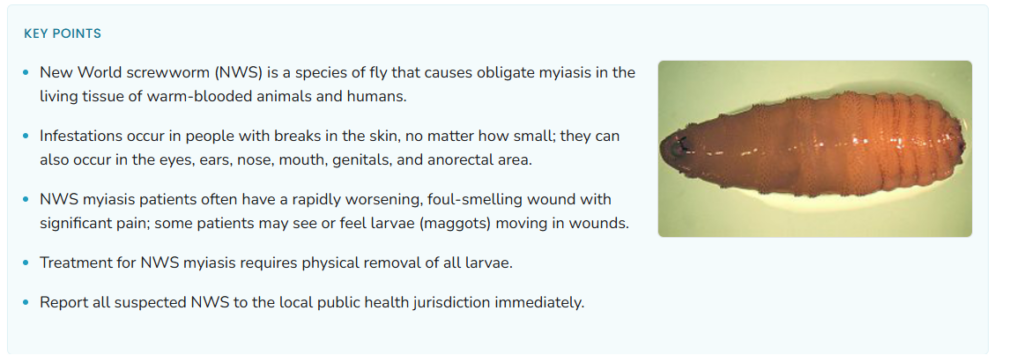
To effectively monitor and combat the pest, producers must understand its biological timeline and behavior. The New World screwworm operates on a rapid life cycle that allows infestations to establish quickly if left unnoticed.
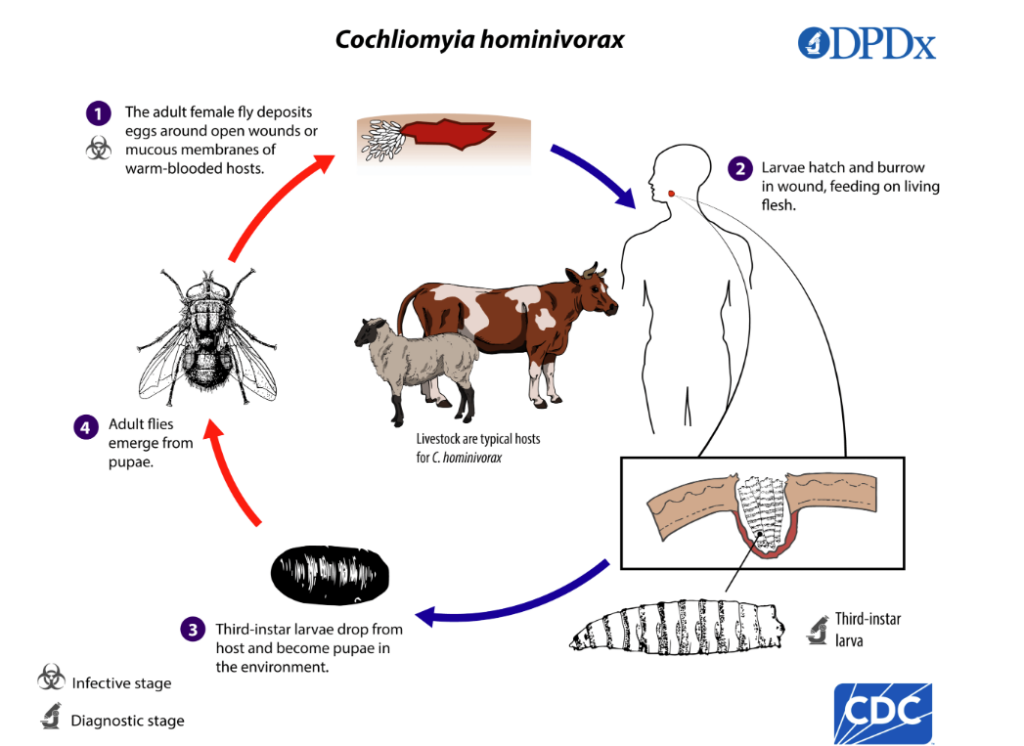
“This particular fly has a life cycle that’s about two to three weeks,” Dr. Biggs stated. “We’re going to start here with the female fly is going to lay her eggs typically at a wound. It can also lay its eggs near natural body openings, so think nasal passages, the navel or umbilicus of newborns, or genital openings.”
Once the eggs are deposited, the transition to the destructive larval stage happens in less than a day.
“From those eggs being laid, it’s about a 10 to 20-hour hatch,” Dr. Biggs explained. “And then those eggs will move into the larva stage, which is really where we see the maggots, right? And it goes through first, second, and third instar levels. That larval period, if you will, is about a five to seven day.”
After completing their feeding stage on the live host, the larvae enter the soil to complete their development.
“After feeding, those larvae drop off the animal, they burrow into the soil and pupate,” Dr. Biggs said. “That’s another five to seven-day period, and then that adult fly emerges and will live up to about two weeks.”
Distinctive Behavior and Targeted Hosts
Unlike typical blowflies that consume dead tissue, the screwworm is uniquely hazardous because it requires living flesh to survive. This distinction is critical for producers trying to differentiate a routine maggot issue from a standard screwworm infestation.
“This particular fly does not have a preference for dead and decaying tissues,” Dr. Biggs emphasized. “So if we have a deceased animal and we see maggots, highly, highly unlikely that those are screwworm maggots. If we’re seeing maggots on a live animal, that potentially puts us in a different discussion.”
While the primary focus remains on cattle production, Dr. Biggs reminded owners that the screwworm does not discriminate among warm-blooded hosts.
“New World screwworm can infest any warm-blooded animal,” Dr. Biggs warned. “So we have certainly the livestock concern, we have the companion animal concern in dogs and cats, we have the wildlife concern—which looks very different than the last time we saw that here in the United States—and we can, although rare, also see it in humans.”
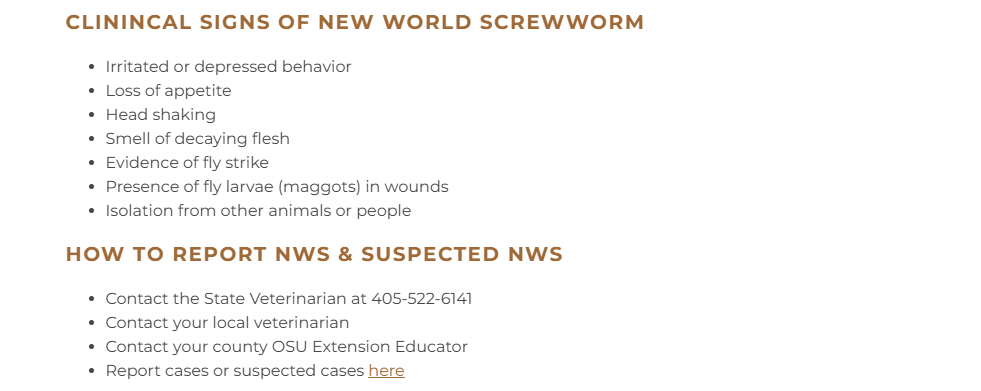
When inspecting wounds, producers should look for specific, aggressive burrowing behavior.
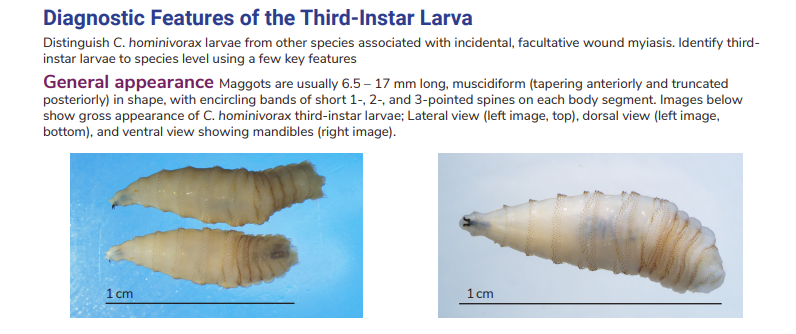
“These screwworms do have a particular pattern in most cases that they will situate themselves,” Dr. Biggs noted. “They burrow or screw—hence the name—down into that tissue to feed.”
However, visual inspection alone may not be definitive, as multiple fly species can inhabit the same injury. “We can have mixed presence of different types of blowfly maggots in the same wound,” she added, emphasizing the need for professional evaluation.
Proactive Management and Biosecurity
Oklahoma agricultural agencies and university extension networks have been quietly preparing for this threat long before the recent outbreaks.
“We’ve been preparing for New World screwworm certainly,” Dr. Biggs said. “The State Veterinarian’s office, as part of the Oklahoma Department of Agriculture, Food, and Forestry, has been talking about it with their working group for 18 to 24 months. From the OSU Extension standpoint, some of my colleagues and I have been trying to let producers be aware, be looking for it, but now we really need a heightened awareness and response.”
A cornerstone of this heightened response is the implementation of rigorous daily biosecurity practices on the farm.
“I’ve been trying to get producers to evaluate their biosecurity practices, which, really, is the hallmark of my biosecurity, which is regular inspection, and really, daily inspection,” Dr. Biggs said.
This inspection means paying close attention to vulnerable animals, particularly newborns and those undergoing routine management procedures.
“If we’ve got new babies hitting the ground, we need to make sure that we’ve got the opportunity to make sure those navels are taken care of appropriately and be keeping an eye on all our animals in a much closer way than we have been,” Dr. Biggs advised.
Evaluating Summer Management Practices
The standard seasonal operations of branding, dehorning, and castrating create open wounds that invite screwworm flies to deposit eggs. Producers are encouraged to review the timing of these activities with their veterinarians to minimize risk.
“We need to be really thinking about those practices, and can we do those at times of the year at this point that may not have such a threat of the New World screwworm fly being present” Dr. Biggs suggested. “I’m cautious to delay folks on some things, but I will tell you, I’m not generally a recommender to do a lot of processing in the summer with the heat anyway, from a welfare standpoint, but we need to be thinking about a plan and potentially delaying those.”
For long-term herd management, genetic selection offers a permanent solution to the risks associated with mechanical dehorning.
“The best way to dehorn, of course, is to use polled genetics in your breeding program and unless that’s, you know, you’re a purebred producer that must have horns, let’s make if we’re making those kind of decisions now, let’s go ahead and get ahead of the game,” Dr. Biggs recommended.
Additionally, producers should ensure their physical facilities are ready if animals require individual medical isolation or herd-wide preventative applications.
“We need to be evaluating our facilities and the locations we have our animals at to make sure we have appropriate facilities if we are going to have to administer preventatives or treatments,” Dr. Biggs noted.
Advanced Treatment Options and Tools
While the return of the screwworm causes understandable concern, the modern veterinary toolkit is significantly more advanced and effective than it was during the mid-20th-century eradication campaigns.
“Many producers, my father certainly remembers… we were much more limited than we are now,” Dr. Biggs said. “We have our macrocyclic lactones, we have our topical pesticides, we have a number of our preventatives for our companion animals that are typically used for flea and tick, but there are also a number of them that are approved for screwworm use.”
Regulatory bodies and pharmaceutical partners have worked collaboratively to ensure these treatments are accessible for emergency situations.
“We’ll give kudos to our partners in the FDA getting a lot of those products on the approved list,” Dr. Biggs stated. “That list is continuing to grow longer, which is good news for us. And our partners in industry that saw this coming and were really prepared to have that ready to go on the label for emergency use. I think we are better suited than we ever have been.”
Overcoming the Fear of Reporting
A significant barrier to effective pest control is livestock owners’ hesitation to report suspected cases due to fears of catastrophic economic or regulatory penalties. Dr. Biggs clarified that the regulatory framework for an insect infestation differs from that for a highly contagious viral or bacterial outbreak.
“The advantage to us over some other of our contagious diseases—keep in mind, this is an infestation of an insect, it is not a contagious infectious viral or bacterial disease,” Dr. Biggs explained. “And so, there are potential movement restrictions based on the identification of the agent. Additionally, though, we’ve got some better options, and that’s part of the plan to try to keep up with regular business as we can.”
The primary objective of early reporting is containment to prevent the pest from becoming a permanent resident in local ecosystems.
“We do not want these particular flies to get established in the environment,” Dr. Biggs emphasized. “And so if we have something that we’re suspicious of, we need to contact our veterinarian, we need to get that information, get samples submitted, have the State Veterinarian involved.”
With high-traffic summer events underway, maintaining compliance and communication is vital.
“We got a lot of shows going on this summer, for instance—horse shows, cattle shows, junior nationals are in full swing, we’ve got swine exhibitions—all of those kinds of things rolling,” Dr. Biggs observed. “We want to think about whether we—we don’t want to travel without appropriate preparation. Each of us has got to do our part.”
Establishing Professional Protocols
The most critical step an Oklahoma producer can take today is to ensure they have an active, functional relationship with a local practitioner.
“We cannot, first and foremost, we cannot overemphasize the need to have a Veterinary-Client-Patient Relationship,” Dr. Biggs stated. “Having that Veterinary-Client-Patient Relationship is really critically important, especially now as it relates to New World screwworm.”
Veterinarians serve as the direct link to state and federal updates, ensuring that diagnostic protocols are followed accurately.
“Veterinarians are tuned in to announcements and should be getting regular communications with the State Veterinarian’s office, with ODAFF, as well as USDA,” Dr. Biggs said. “If we’re suspicious of it, let’s take samples from deep in the wound and let’s get them submitted.”
For producers in remote areas who face challenges accessing immediate veterinary care, alternative diagnostic resources have been established statewide.
“We recognize that not all locations have ready access to a veterinarian,” Dr. Biggs acknowledged. “And so we have, in partnership with ODAFF, OSU Extension has collection kits at each of the OSU Extension offices in all 77 counties, so that is an option as well.”
Ultimately, state officials are prepared to assist producers through the verification process without unnecessary delay. “The State Veterinarian’s office is taking it seriously and will do everything they can to help facilitate it if a producer has a suspect animal,” Dr. Biggs concluded. “They’re going to take that seriously and get that evaluated.”