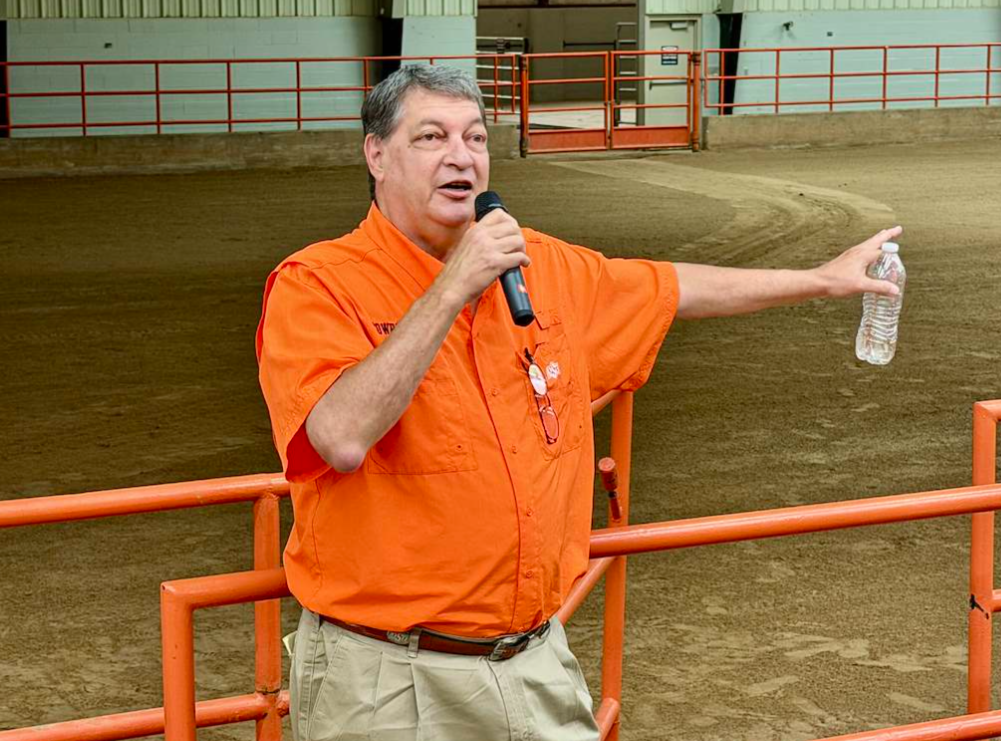
As Dr. Jerry Fitch’s retirement becomes official at Oklahoma State University, the longtime animal science professor says that while he may be stepping away from full-time duties, he is far from done serving Oklahoma agriculture. In a conversation with senior farm and ranch broadcaster Ron Hays, Fitch reflected on his decades-long career in teaching, extension, and agricultural leadership development, while emphasizing his continued commitment to the industry he has spent a lifetime supporting.
“I’m retiring, but I’m still around here,” Fitch said. “We’ll take a couple of months and just travel and do those kinds of things, and then maybe we do something else in the fall. But I am an animal scientist, true and true.”
Fitch said his connection to OSU runs deep, dating back to 1988 when he joined what he described as the nation’s top animal science program. “I was fortunate that in 1988 I was asked to come to the number one animal science program in the nation, and for that reason I never left,” Fitch said. “I’ve had a really, really great career here, and a lot of good students. It’s been a great run.”
Building the Next Generation of Agricultural Leaders
Among the many accomplishments during his career, Fitch pointed to the Oklahoma Ag Leadership Encounter (OALE) program as one of his proudest achievements. “Probably my highlight, the things that I really, really cherish, is the OALE program,” Fitch said. “That’s something we started in 2003 and it has been even more than I could have ever expected, but we’ve trained a lot of the next generation of leaders.”
Fitch explained the program was created to fill a leadership gap in agricultural education. “We had the FFA program that’s second to none in the nation, the OALP program that is phenomenal,” he said. “We didn’t have anything for college students, and so that’s what we tried to put together—something that would be great leadership training for the next generation of agricultural leaders.”
Even in retirement, Fitch plans to stay involved with OALE and continue mentoring young agricultural leaders. “I am still going to do some things with OALE for the next two or three years at least,” he said.
Advocating for Animal Agriculture
Fitch also highlighted his capstone class at OSU as one of the most meaningful parts of his teaching career, particularly because it focused on preparing students to advocate for animal agriculture. “One of the things I am very proud about is the capstone class, and the fact that we do everything we can to teach our students how to advocate for animal agriculture,” Fitch said.
He stressed the growing importance of helping future agricultural leaders communicate with consumers and defend modern livestock production. “We get so many things shot at us in animal agriculture, we have to have that,” he said. “Our students are the greatest advocates out there, and they need to understand how to do that.”
Fitch emphasized that proper animal care remains central to livestock production. “They need to understand that we do everything we possibly can to take care of our animals the best way possible until the time they become food,” he said.
From Sheep Extension to Industry Leadership
Early in his career, Fitch served primarily as an extension sheep specialist, devoting much of his time to helping producers improve flock management and genetics. “When I started here, I was 70% extension sheep specialist,” Fitch said. “When I finished here, it was down to about 20% because my teaching role just grew and grew and grew.”
During that time, he worked on major sheep industry issues, including the Oklahoma sheep improvement program and research involving spider syndrome. “We did a lot of things with the Oklahoma sheep improvement and the ram test station and spider syndrome,” Fitch said. “I was chairman for the National Task Force on Spider Syndrome.”
Growth in Students and Small Ruminants
Fitch has seen enormous change within the OSU Animal Science Department over the past three decades, particularly in student enrollment. “When I got here, we had 476 students,” he said. “Now we have over 1,150, so that has grown dramatically.”
He also noted major changes in sheep production systems, especially the rise of hair sheep. “Today we’re seeing more and more hair sheep take over, and it’s working,” Fitch said.
Beyond sheep, Fitch sees continued momentum in the broader small ruminant sector, including goats. “I would say overall, let’s just talk small ruminants, both sheep and goats—yeah, we’re seeing major growth in the last four or five years in the small ruminant populations,” he said. “I think that’s only going to keep growing.”
Youth Livestock Programs Fuel Expansion
Fitch believes much of that growth is being driven by youth livestock programs across Oklahoma. “The goat side of things has grown, the sheep side of things has grown, and I don’t see that changing,” he said.
He credited programs like the Oklahoma Youth Expo and the Tulsa State Fair livestock shows for encouraging youth participation. “I think our youth programs in this state are phenomenal,” Fitch said. “I think it’s going to keep growing.”
For Fitch, the livestock themselves are only part of the equation—the real value lies in what young people learn through raising animals. “We utilize the animals for students to gain responsibility, work ethic, and those kinds of things,” he said. “That’s still the true reason for these livestock projects.”
A Career Measured by Lives Changed
As colleagues and former students gathered to celebrate his retirement, Fitch said the most meaningful part of his career has been the people he impacted. “It’s really, really satisfying,” Fitch said. “I appreciate the comments. I appreciate all the individuals who showed up here today to roast me or talk about the good things, too.”
Reflecting on more than 30 years of service to Oklahoma agriculture, Fitch expressed gratitude for every step of the journey. “It’s been a great run,” he said. “I’ve enjoyed every minute of it.”
While retirement marks the end of one chapter, Fitch made clear his passion for agriculture remains unchanged. “I am,” he said when asked if he is ready for the next phase. “It’s time. Brian and I are gonna do a lot of traveling this summer, and then we’ll see what the future holds after that.”
Congratulations and happy retirement, Dr. Fitch.