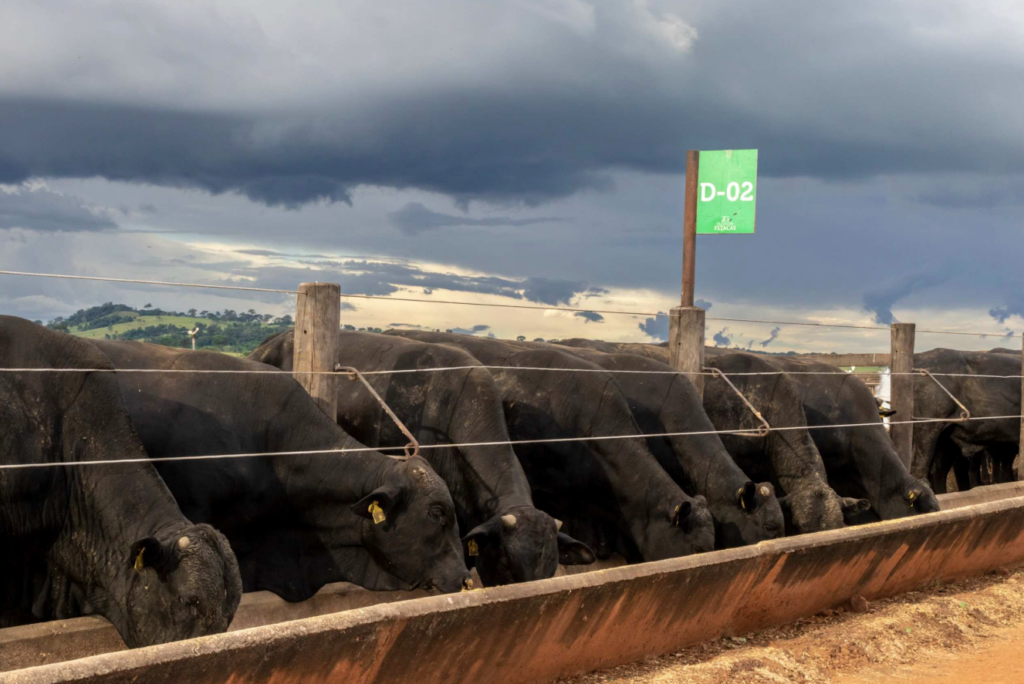
Bovine congestive heart failure in cattle is becoming an increasingly important issue for the beef industry, especially in feedlots where cattle are being finished to heavier weights. In a conversation with Associate Farm Reporter Carli Davenport, Mark Johnson, OSU Extension beef cattle breeding specialist, explained what producers need to know about the disease and how genetics may help reduce future losses.
Johnson said bovine congestive heart failure, commonly shortened to BCHF, has also been referred to in recent years as “late day morbidity” or “late stage morbidity.” He explained that the condition is primarily seen in feedlot cattle after they have been on feed for an extended period.
“We’ve come to talk about it more as bovine congestive heart failure, or BCHF, and it is fundamentally cattle in feedlots, often after they’ve been on feed for a while, they’re having heart failure,” Johnson said. “It is right ventricular heart failure. Often once they’ve been on feed for a few months, they’re dying of heart attacks.”
Recognizing the Signs of BCHF
Johnson emphasized that BCHF remains a deadly condition with no effective treatment options. “The thing about bovine congestive heart failure—it’s untreatable, it’s fatal,” Johnson said. He noted that some physical signs may resemble other cattle health issues such as hardware disease or altitude sickness. These similarities can make diagnosis difficult for producers.
Johnson recalled an example from an OSU trip to the National Western Stock Show in Denver, where a bull developed altitude-related symptoms. “The brisket begins to swell,” he said. “We basically shipped that bull back to Oklahoma, and he recovered, and he’s fine.”
Unlike altitude sickness, however, cattle suffering from BCHF do not recover. Johnson said producers may observe several warning signs in affected cattle. “Brisket enlargement, you might be able to see the jugular vein alongside their neck a little easier, some edema in their lower body, things like that,” Johnson said. He added that as cattle fatten, some of these physical changes can be difficult to distinguish from normal finishing traits.
Understanding Heart Scores in Cattle
One of the most important tools researchers are using to study BCHF is the heart scoring system, which evaluates how much remodeling has occurred in the heart. An article from Johnson about this topic can be found here.
Johnson explained that researchers have been investigating unexplained feedlot deaths for decades. “Going back 25 to 30 years, we’ve seen a higher incidence of cattle dying at the end of the feeding period,” Johnson said. “You start looking for causes—was it pneumonia, had they become chronic, what was causing this?”
Post-mortem examinations helped researchers identify a consistent pattern. “The right ventricle of the heart is significantly remodeled,” Johnson said. “It’s basically worn out, and that’s been the cause of heart failure.”
Heart scores range from one to five:
Heart Score 1 = Normal, healthy heart
Heart Scores 2–4 = Increasing levels of remodeling
Heart Score 5 = Severe remodeling, often associated with fatal BCHF
Johnson said the goal is to identify cattle with healthier hearts and eventually use that data to improve breeding decisions. “A heart score of one shows a perfectly normal, healthy-looking heart,” Johnson said. “Heart score five means probably the disaster has happened.”
Genetics May Hold the Key
While environmental factors can contribute to heart failure, Johnson believes genetics play a major role in BCHF susceptibility. He explained that researchers are collecting heart score data at harvest and analyzing it alongside pedigree, age, and performance records to better understand inheritance patterns. “We have learned that this is a polygenic trait,” Johnson said. “There are multiple genes involved in this heart remodeling.”
Because the trait appears to be influenced by multiple genes, researchers hope to eventually develop genetic selection tools, such as an Expected Progeny Difference (EPD), specifically for heart health. “We can generate an EPD, an expected progeny difference, or a selection tool at some point in the future that gives us the potential to select for healthier hearts,” Johnson said. That would give cattle producers another way to reduce losses from the disease over time.
Economic Impact on the Beef Industry
Johnson said BCHF is more than a health concern—it is an economic issue with major implications for feedlot profitability. Modern cattle are being fed to heavier finish weights than they were decades ago, and Johnson said that shift may be contributing to the rise in cases. “Going back 25 to 30 years, we are seeing a higher incidence of bovine congestive heart failure,” Johnson said.
In severe cases, losses can be substantial. “There are recorded lots of cattle where upwards of 7% or more of them have died of bovine congestive heart failure,” he said. “So it’s a very significant form of loss. It really can impact the bottom line.”
Even so, Johnson said early genetic research is encouraging. “It looks encouraging,” Johnson said. “Some of the initial estimates of heritabilities for heart scores are coming back in the low to moderate range.”
As more data is collected, researchers hope to better determine how much of BCHF risk is genetic and how effectively producers can breed against it. “As more phenotypes are collected and more data comes in, it permits us to connect the dots better,” Johnson said. “How much of the variation in heart scores and heart failure can we explain as a result of genetics, and then parlay that into selection tools?”