

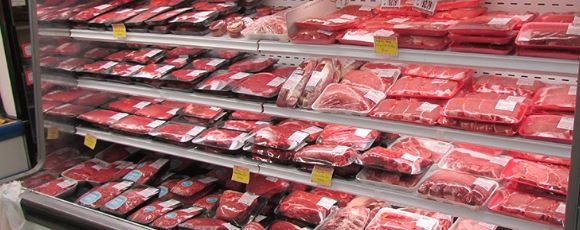
In today’s Beef Buzz, Senior Farm and Ranch Broadcaster Ron Hays features comments from Kansas State University agricultural economist Glynn Tonsor about the June Meat Demand Monitor, a monthly survey funded by the beef and pork checkoffs that measures consumer attitudes toward meat purchases. After months of growing pessimism about household finances, the latest report offers an encouraging change in direction.
Tonsor said the biggest headline from the June survey isn’t necessarily meat demand itself, but a noticeable improvement in how consumers view their own financial situation. “There’s a positive improvement in financial sentiment. That’s probably the most important point I want to interject,” Tonsor said. “Too early to tell if that’s a new trend or if it’s a one-month anomaly, but I’m starting there because I’ve been saying most of 2026 the public’s gotten more pessimistic on their finances.”
He explained that throughout much of the year, consumers have increasingly reported feeling worse off financially than they were a year earlier, creating what economists call a “headwind” for beef demand. While the June numbers don’t erase those concerns, they do suggest conditions may be beginning to improve.
The Numbers Point to a Better Outlook
According to Tonsor, 19 percent of respondents said their finances are better than they were in June 2025, while 34 percent reported being worse off. Although that figure remains elevated, it marks an improvement from May. “I would love that 34% to keep shrinking, but it has shrunk compared to May.”
The largest group of consumers continues to report little change in their financial situation. “Same would basically be as, like, I’m in the same financial position as I was a year ago—it hasn’t deteriorated, and that’s good,” Tonsor said. “That group is regularly the most common, so here in June, 47% of the public said their finances were the same as June of ’25.”
What really matters, he said, is watching how the remaining half of consumers split between improving and worsening financial conditions. “What I really think the action in these numbers is how the other half is split, even more narrowly. How big is that bottom K? How big is the group saying they’re getting worse? That’s what’s been growing the last few months.”
Tonsor noted that those findings mirror broader discussions taking place across the economy regarding affordability, housing costs and inflation. “That’s what’s been showing up in the papers on the much broader affordability discussion and housing affordability and lots of things right outside of meat.”
Why Financial Sentiment Matters for Beef Demand
The relationship between consumer finances and meat demand is straightforward, Tonsor explained. “The more people we have that say their finances are doing worse, the bigger the headwind on meat demand, because meat’s what we call a normal good.”
As household income or expected income changes, purchasing behavior follows. “Demand goes up when income goes up, demand goes down when income goes down, and a step from that is demand goes down when expected income goes down.”
While the survey doesn’t ask consumers why they feel more optimistic, Tonsor believes improving news surrounding inflation and energy costs may have influenced responses collected during the middle of June. “This isn’t in the survey, but a best guess—the initial truce discussion between the U.S. and Iran, some hope of what that means for gas prices, maybe some hope for broader inflation—that probably was on the minds of people when the survey was getting the bulk of its responses.”
Whether those developments prove lasting remains to be seen, but Tonsor believes the shift in financial outlook is directly connected to stronger meat demand indicators. “I think there was an improvement in demand, and I think it directly aligns with some improvement in sentiment.”
Consumers Indicate They’re Willing to Spend More
The Meat Demand Monitor doesn’t simply ask consumers whether they plan to buy meat. It measures how much they are willing to pay for several popular products at both grocery stores and restaurants. “In the MDM, we track two beef items—ribeye steak and ground beef—two pork items, pork chops and bacon, chicken breast and a couple other categories.”
The survey also measures willingness to pay for meals eaten away from home. “We track what you’re willing to pay at the grocery store, so think at-home meat demand. Then we track away from home, so think restaurants specifically.”
The June report showed encouraging movement across nearly every category. “Pretty much across the board, the meat demand numbers—what you want to pay per pound or per dinner meal—was up in June compared to May, and that is great.”
Was May the Low Point?
Tonsor said those results are particularly encouraging because other industry data had pointed toward weakening meat demand only a month earlier.
He referenced retail scanner data compiled by meat industry analyst Anne-Marie Roerink, which tracks actual grocery purchases across the country. “The May data Anne-Marie put out was showing weakness in the meat demand space. That was a fairly new statement—not a fun one to talk about.”
Those numbers raised concerns that beef demand may have been beginning to soften after several years of strength. “Those of us who geek out in this space were quite concerned. Was May a turning point specifically for beef demand? To be determined.”
Because the Meat Demand Monitor serves as an early indicator ahead of retail sales data, Tonsor said June’s survey offers hope that the market may already be improving. “This initial look from the MDM—that’s the whole point of the survey, is it’s ahead of that—is maybe May was the low point, and we’re getting better. Looks like June might be better.”
Cautious Optimism Going Forward
While Tonsor cautioned that one month’s data does not establish a trend, he believes June provides reason for cautious optimism after several difficult months.
He also noted that the Meat Demand Monitor asks questions similar to those used in national consumer confidence surveys, making it another valuable gauge of household sentiment. “The University of Michigan’s Consumer Sentiment Index gets seen a lot in the broader press. We’re asking similar questions here, so we’re following the same methods. I hope to see in the next few weeks that sentiment has improved.”
The Beef Buzz is a regular feature heard on radio stations around the region on the Radio Oklahoma Ag Network and is a regular audio feature found on this website as well. Click on the LISTEN BAR above for today’s show and check out our archives for older Beef Buzz shows covering the gamut of the beef cattle industry today.







