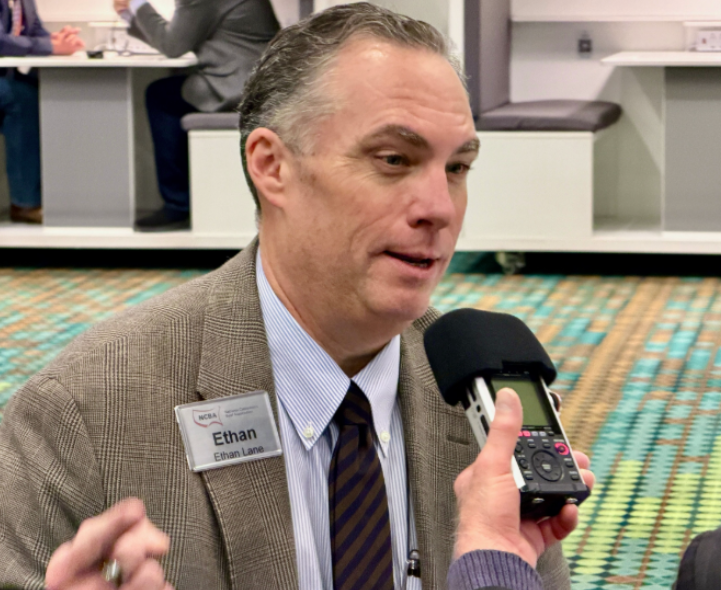
In today’s Beef Buzz, senior farm and ranch broadcaster Ron Hays features comments from Ethan Lane, senior vice president for governmental affairs for the National Cattlemen’s Beef Association, following a National Association of Farm Broadcasters webinar. Lane discussed the ongoing push for mandatory country of origin labeling and concerns about outside groups influencing livestock policy through major spending. Part one can be found here.
Mandatory Country of Origin Labeling
Lane said mandatory country of origin labeling, or MCOOL, could add costs for both cattle producers and consumers without necessarily increasing demand for U.S. beef. “The logic of pushing mandatory country of origin labeling in an environment where producers are complaining about high input costs and high cost to produce that product, at the same time that everyone is focused on lowering consumer prices, MCOOL would do two things right away,” Lane said. “It would raise costs for producers to comply with it, and it would raise the price of our product for consumers at the store. What it wouldn’t do is drive demand.”
Lane pointed to recent research from Kansas State University that examined what consumers consider when purchasing beef. “Consumers buy on price and quality, and they’re matching those two up right now when they go to the store,” Lane said.
He said the current conversation surrounding MCOOL has also been influenced by additional lean beef trim entering the U.S. supply chain through tariff agreements. “We know we need that lean trim to make our ground beef supply and to meet those needs across the supply chain,” Lane said. “We raise heavily marbled cattle in this country. We raise cattle that are designed to produce that Prime New York strip that I enjoyed at a steakhouse in Kansas City earlier this week. What doesn’t come off that animal is 80/20 or 90/10, right? And so we need those sources of lean trim.”
Lane said the beef industry needs to consider how additional supplies of imported trim fit into the overall supply chain. “When you start artificially trying to juice those into the supply chain without maybe understanding how they match up, right? Who’s asking for it, or if anyone is asking for more of it, it starts to have these kinds of effects,” Lane said.
Voluntary Product of USA Label
Instead of mandatory labeling, Lane pointed to USDA’s voluntary Product of USA labeling program as an alternative. “The voluntary Product of USA label fixes that labeling issue that consumers and producers were concerned about,” Lane said.
He said the program can give consumers more information while allowing producers to pursue premiums through branded beef programs. “We’ve been proud to work on closing that loophole. We’ve been pleased that USDA has pushed that program,” Lane said. “We feel like that is a far better alternative as we look for ways to make sure that we’re leaning into the premiums and the branded products and the things that are truly generating some premiums for our producers, rather than just saddling them with more cost.”
Concerns Over Prop 12 Advocacy
Lane also discussed Proposition 12 and broader efforts by animal rights and activist organizations to influence livestock policy.
He questioned where the funding behind some of those advocacy efforts is coming from, particularly when organizations describe themselves as representing small farmers. “How does an initiative being led by groups like the American Meat Producers Association, who claim to represent small farmers or Farm Action for that matter, that spent 30 million dollars opposing the Save Our Bacon Act in June alone,” Lane said.
Lane questioned how organizations representing a relatively small portion of agriculture could spend that level of money on policy advocacy. “I represent the largest segment of American agriculture and the largest organization in that segment of American agriculture. We couldn’t even contemplate getting enough producers together to have 30 million dollars,” Lane said.
He said the livestock industry should take a closer look at the sources of funding behind those efforts. “So where did those small farmers come from, or is that money coming from open philanthropies network or other activist groups that are trying to deceive members of the Senate and capitalize on this conversation right now?” Lane said.
Lane said the influence of those efforts is concerning for livestock producers. “It is incredibly disappointing to see that having the effect that it’s having throughout the livestock industry,” Lane said. “And I would encourage folks to really ask some questions about where that advocacy is coming from and who’s writing the check for it.”
The Beef Buzz is a regular feature heard on radio stations around the region on the Radio Oklahoma Ag Network and is a regular audio feature found on this website as well. Click on the LISTEN BAR above for today’s show and check out our archives for older Beef Buzz shows covering the gamut of the beef cattle industry today.