

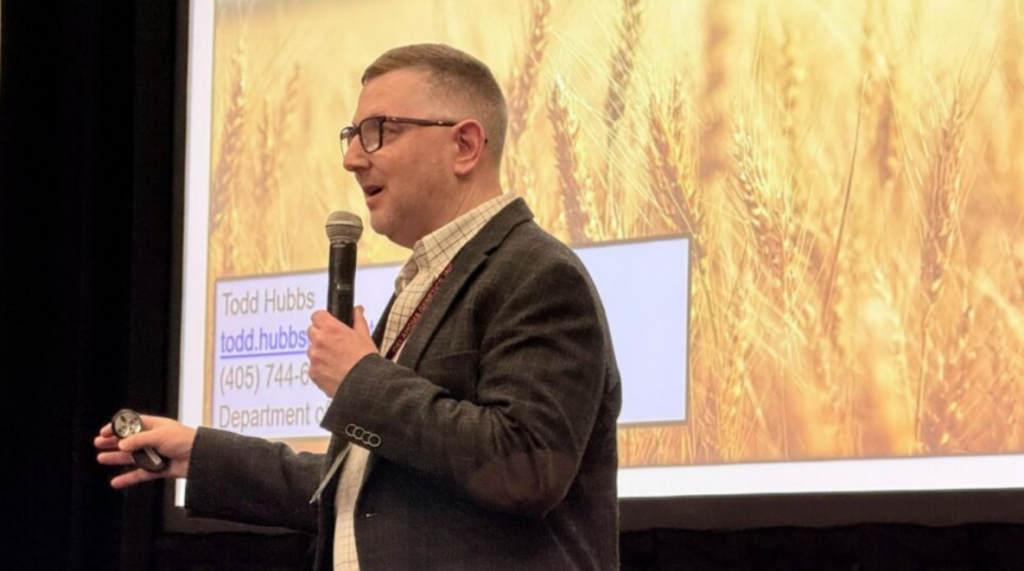
Following the release of the USDA Small Grains Summary and Quarterly Grain Stocks report, Oklahoma wheat marketing decisions are top of mind for producers navigating tight margins and heavy global export competition. Farm Director KC Sheperd recently sat down with Oklahoma State University Extension crop marketing specialist Todd Hubbs to examine the numbers and discuss risk management strategies for regional growers.
Looking at the wheat balance sheet, Hubbs indicated that final production numbers aligned closely with industry projections, though domestic usage came in slightly stronger than anticipated.
“In wheat, not really,” Hubbs said regarding major surprises. “It was pretty close to where everybody thought and the trade thought, both on production. A little bit stronger first-quarter usage in wheat than I think some expected, but it’s not a huge number.”
The larger market disruption stemmed from corn inventory adjustments.
“I guess the biggest surprise for most people was the corn stocks number,” Hubbs explained. “It was higher than expected, which is going to push up ending stocks into the out year, and we saw that reflected in the market. They basically lowered last year’s acreage slightly, and it implies feed and residual use, in particular residual, was much smaller in the fourth quarter.”
Global Pressures on Oklahoma Wheat Marketing
Despite a tighter hard red winter (HRW) wheat crop domestically, cash bids continue to struggle because U.S. export values remain uncompetitive on the world stage. Hubbs noted that aggressive export flows from Russia and Ukraine have kept international tender values well below U.S. Gulf offers.
“Well, we had a small crop in HRW, and we’re not really moving it,” Hubbs said. “Our price is still well above the world price and our major competitors. I think you’ve seen some of that premium put in from the Black Sea getting taken out of the wheat market a bit as Russia has been moving more of their wheat than maybe some people expected in September. We’ve seen their trade flows be a little bit higher than a lot of the trade was expecting. They’re moving it through the Azov and the Baltic, and Ukraine is moving theirs as well.”
Hubbs pointed out that international purchases of HRW wheat have largely been limited to Mexico and Japan. While white wheat exports have performed well, HRW sales continue to lag.
For producers planting wheat solely for grain production, input expenses present a challenging breakeven calculation. Hubbs emphasized that growers should keep their crop insurance guarantee top of mind.
“I think folks need to remember that the projected crop insurance price for HRW in Oklahoma came in at $8.11, which is well above where we’re currently at both cash and in the futures,” Hubbs said. “When you’re thinking about marketing, your breakeven, if you took crop insurance—which I think most people do—be thinking about that as part of your risk management plan.”
Developing Practical Oklahoma Wheat Marketing Plans
With diesel fuel fluctuating and fertilizer holding steady, overall profit margins remain compressed. Hubbs advised producers holding old-crop grain to evaluate their carry costs carefully rather than speculating on extended rallies.
“If you’re sitting on some old-crop grain, this weakness we’ve seen recently, I don’t know if we’re going to come back barring some kind of issue,” Hubbs said. “That issue would probably be early into next year because we’ve seen Black Sea, particularly Russian wheat planting, be really slow thus far for next year’s crop. But that’s a long time to wait and speculate on something like that. If you’re still hanging onto it and you’re not planning to carry any, you might want to think about getting rid of that.”
Given favorable cattle prices, grazing out wheat pasture may offer a more dependable return than holding grain for a speculative spring run.
“I’m not expecting a huge rally in the spring, but sometimes these things occur,” Hubbs noted. “It’s all about the weather and these geopolitical issues, and those are very uncertain. You need to sort of plan out and think, ‘Where would I need to be cash on grain relative to grazing it off?’ And it’s sort of leaning toward grazing off if you’re in that situation, the way I see the market playing out.”
When looking at overarching wildcards over the next 90 days, Hubbs concluded that geopolitical developments and their direct impact on input and energy costs remain paramount. Effective Oklahoma wheat marketing will require staying nimble as trade corridors and global energy prices evolve.
“I think it’s just the geopolitical issues, both in the Gulf and in the Black Sea,” Hubbs said. “If there’s any kind of resolution to this Iran conflict and we could see energy prices come down, maybe get diesel prices even a dollar lower, that would be tremendous. We could see some things start to move around for us based on our margins and just our shipping and our ability to export.”







