
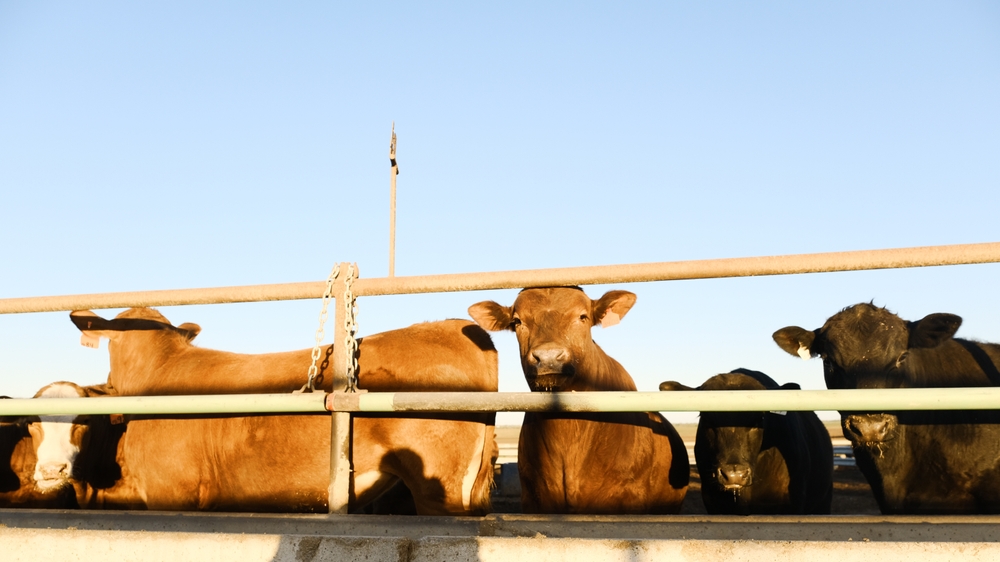
In today’s Beef Buzz, senior farm and ranch broadcaster Ron Hays spoke with Oklahoma State University Extension Beef Cattle Specialist Dr. David Lalman about ways cattle producers can identify more efficient replacement heifers and manage the long-term cost of maintaining their cow herds. Lalman says one simple strategy involves turning prospective replacement heifers out on grass and measuring how much weight they gain. Part one of this conversation can be found here.
Letting Heifers Graze Can Reveal Their Efficiency
Lalman says producers can learn a lot about a heifer’s future efficiency by measuring her performance following weaning. After a short preconditioning period, he recommends weighing prospective replacement heifers, turning them out on available forage for 70 to 100 days, and weighing them again. “That gain, post-weaning forage gain, turns out to explain a high percentage of their efficiency, and that’s really all it takes,” Lalman said.
He says this approach can help producers identify females that have the ability to gain more weight without requiring additional feed.
Lalman shared an example from an OSU research group of 55 heifers evaluated this past summer. “We had 55 heifers and one heifer gaining eight tenths of a pound a day and consuming 14.7 pounds of hay over a 90-day test,” Lalman said. “There’s another heifer in that group that’s gaining two pounds a day, and guess what? Consuming exactly the same amount of hay over that long test period.”
“Phenomenal, and she’s not eating anymore. She’s not costing you anymore. So why wouldn’t we do that?” he added.
Lalman says identifying those differences can help producers select females that are more efficient and potentially less expensive to maintain over their lifetimes.
Should Producers Develop Their Own Heifers or Buy Bred Females?
Hays also asked whether producers are better off developing replacement females from their own herds or purchasing bred heifers, especially with the current investment required to buy females ready to calve.
Lalman says the answer depends largely on the producer’s resources, facilities and interest in managing replacement development. “Do they have an interest in and capability of first of all growing heifers?” Lalman said. “Do they have the forage resources or maybe pasture availability to add that stocking capacity to their operation?”
He says some producers may also be interested in using reproductive technologies such as synchronization and artificial insemination to make more targeted genetic decisions. “We have the capability now, where people could use sex semen and maybe target their better cows with female semen. That’s a really exciting concept,” Lalman said.
For producers without the facilities, feed storage, pasture capacity or interest in developing their own replacements, purchasing quality bred females can still be a good option. “There’s a lot of benefit for those kind of folks to look for a good quality source of bred females and bring them into their operation,” Lalman said.
Retaining More Heifers Could Give Producers More Options
Lalman said producers could identify the top-performing heifers through a grazing evaluation, keep the best females and use the proceeds from marketing the remaining heifers to purchase bred replacements.
Lalman said he likes the idea of retaining more prospective replacements than a producer actually needs and allowing performance to help determine which females stay in the herd. “I think the idea of retaining more prospective replacements than you need is a really good one,” Lalman said.
He recommends developing those heifers at a moderate rate, targeting gains of around one to one-and-a-half pounds per day through the winter. The goal is to have them reach approximately 60% of their expected mature body weight by the beginning of breeding season.
Producers can then expose the heifers to a bull or use artificial insemination before pregnancy-checking them following a breeding season of approximately 45 days. “Keep the ones that get pregnant early, and the ones that are open are going to make great profitable feeder heifers going to market,” Lalman said.
For spring-calving operations, he notes that marketing those open heifers could also line up with the traditional seasonal peak in feeder cattle prices during July and August.
The Beef Buzz is a regular feature heard on radio stations around the region on the Radio Oklahoma Ag Network and is a regular audio feature found on this website as well. Click on the LISTEN BAR above for today’s show and check out our archives for older Beef Buzz shows covering the gamut of the beef cattle industry today.