

At the Rural Economic Outlook Conference in Stillwater, Farm Director KC Sheperd sat down with Oklahoma State University Extension crop marketing specialist Dr. Todd Hubbs to evaluate where agricultural markets stand following the federal elections, how global pressures are affecting local producers, and what to watch for in upcoming supply and demand reports.
Despite the heightened political climate surrounding election week, Hubbs expressed that he does not anticipate immediate or drastic market swings resulting from the ballot box.
“I don’t see a lot changing from the election,” Hubbs said. “I think this election is probably going to lead to some gridlock at the federal level, and that’s not necessarily a bad thing or a good thing in my opinion—it’s just less gets done. There’ll be a lot of talk and a lot of hullabaloo around what’s going to happen, but at the end of the day, you get a Republican as president and you get a Congress that’s Democrat, so anything that does get through is going to be one heck of a compromise.”
Hubbs noted that political cycles repeat regularly, adding, “I know a lot of folks are probably either happy or sad, but I’m just sort of, yeah, this happens.”
Wheat Planting, Weather, and Current Grain Dynamics
Looking across commodity markets, recent Southern Plains moisture has provided relief, allowing regional winter wheat planting to catch up.
“We’ve seen some pressure, particularly in the wheat markets, running down,” Hubbs explained. “I think our friendly weather here in the Southern Plains—our planting’s caught up to pace pretty good. We’re a little behind in Oklahoma, and around the state emergence looks good. We’ve got some moisture, which is really nice for us. I think the market’s priced in probably a pretty decent crop for the winter wheat crop this year, and not a lot of change in acreage.”
Corn markets have flattened out as analysts await the upcoming USDA production estimates. While Hubbs views the national corn crop as somewhat smaller than current government forecasts suggest, he noted the disparity may not be wide enough to trigger a sharp rally.
Soybeans, meanwhile, saw strong oil usage through August and September, with domestic crush margins remaining favorable alongside steady purchases from China. Hubbs observed that markets appear to be grinding sideways through a seasonal trough, with the potential for modest improvements if export demand accelerates.
Geopolitical Pressures and Persistent High Input Costs
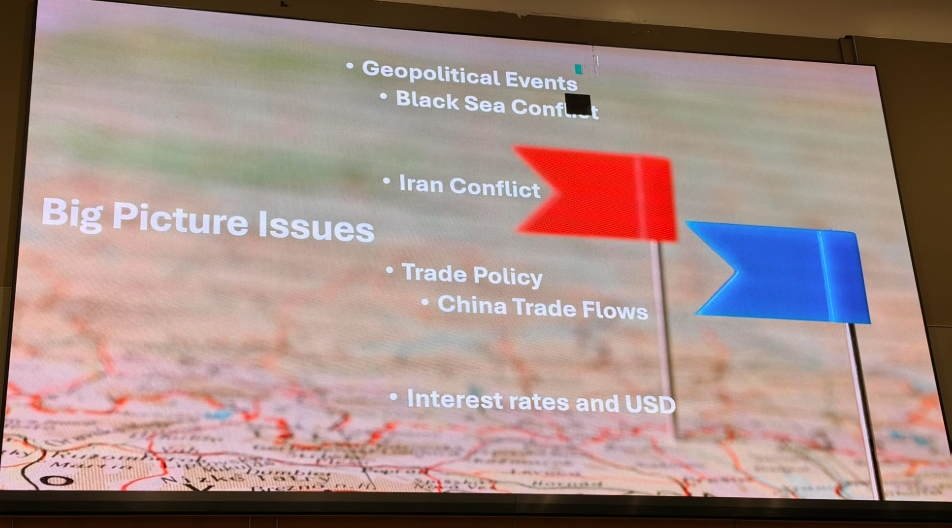
Geopolitical developments continue to influence commodities, though Hubbs pointed out that energy costs and refining constraints remain the dominant headwind for domestic margins. High diesel prices, driven by refining limits, continue to elevate farm costs and eat into local basis.
“I think our costs in the ag sector are still going to be high for the foreseeable,” Hubbs stated. “Even if we solved the Iran problem tomorrow, the issue with diesel and refining and just the capacity to, you know, get the price back down, it’s going to take a while to work through.”
He pointed out that while U.S. producers are feeling the pinch of high fuel, international prices in regions like the European Union have reached equivalent highs of $9 to $10 per gallon. On the export front, the Black Sea conflict continues, but the market has largely absorbed the initial risk premium as Russian shipments adapt through the Baltic and Azov seas.
USDA Expectations and Producer Marketing Advice
Turning to the upcoming World Agricultural Supply and Demand Estimates (WASDE), Hubbs expects mostly marginal balance sheet revisions rather than major shocks. However, he cautioned that wheat producers participating in USDA safety-net programs should monitor the projected season-average price.
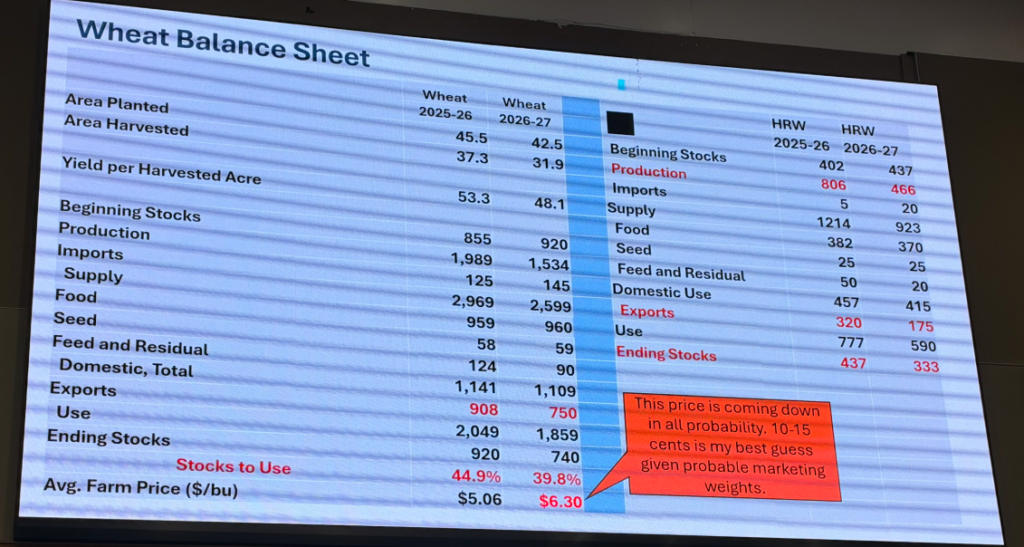
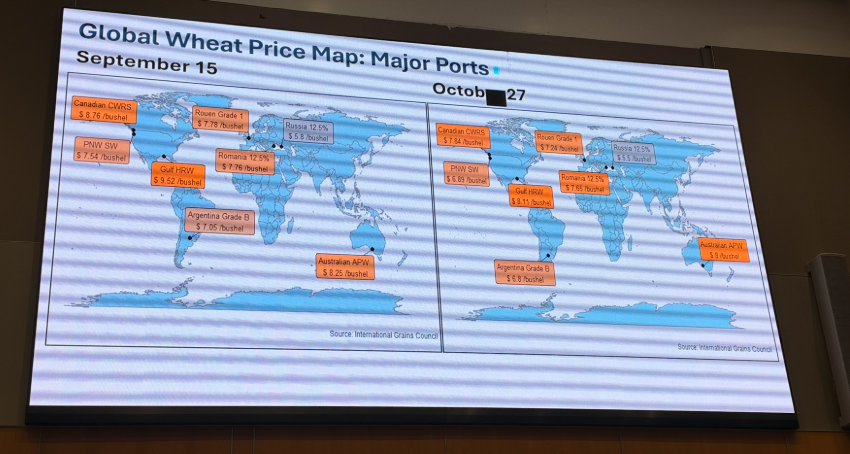
“I do think they’re probably going to lower the price received for wheat,” Hubbs cautioned. “They were at $6.30, but I’m looking at the data coming in and the marketing weights. The only reason I mention this is it matters for people thinking about ARC and PLC. I wouldn’t be surprised if they took a dime or 15 cents out of that. If it sits with normal weights and how we market stuff for wheat through the crop year, it could be lower than that.”
For producers weighing cash sales, Hubbs recommended patience for those who missed earlier rallies, noting that local cash basis has remained comparatively steady despite high freight costs.
“I feel like we’re getting into some lows and settling out,” Hubbs concluded. “Our basis here in Oklahoma has been relatively stable—not great, we had a horrible crop, but we’ve still got a pretty decent basis. With diesel the way it is, transportation is just eating our basis. I’m sort of in a wait-and-see mode if you’re still looking to sell some cash wheat, and if you didn’t get in on that rally that got us to an $8.11 crop insurance, I’m not pulling the trigger right now.”