


Facing economic decline, persistent drought, and rural school funding shortfalls across his northwest Oklahoma district, State Senator Casey Murdock believes the solution might just come in the form of data centers.
In a recent conversation with Farm Director KC Sheperd, Murdock framed the rapid expansion of data centers not merely as a tech industry trend, but as an economic lifeline for rural towns and a critical frontier for national security.
The issue took center stage after Murdock moved forward with an interim study in the Oklahoma Senate. According to Murdock, the initial speaker lineup proposed by a colleague felt overly tilted against the industry. When he insisted on adding experts to discuss economic upside and the geopolitical necessity of artificial intelligence, several scheduled critics backed out, prompting Murdock to hold the meeting anyway.
“We’ve got to educate the public on the truth and what is really going on with data centers, not just the social media rhetoric,” Murdock said.
A Shot in the Arm for Dying Towns
Murdock’s district spans roughly 25.8% of the entire state’s land area, yet is home to just 82,000 residents. In his home county of Cimarron, population density hovers at just one person per 1.5 square miles.
“In the Panhandle and northwest Oklahoma, we’re losing businesses faster than we’re gaining them,” Murdock pointed out, citing the recent closure of the John Deere dealership in Boise City, historically one of the area’s anchor employers.
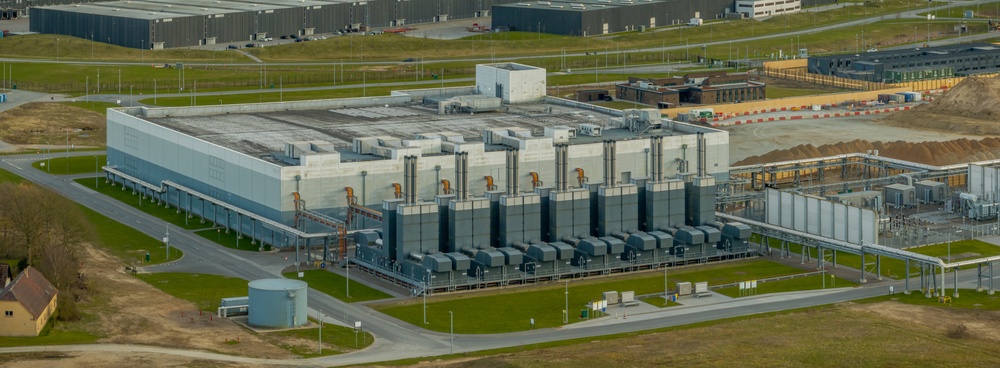
While traditional manufacturing plants demand hundreds of workers—bringing immediate burdens on local housing, roads, and emergency services—data centers operate with a lean on-site staff while delivering an enormous tax base. According to Murdock, an average facility could yield upwards of $25 million annually in ad valorem property taxes. For counties operating on total annual budgets of around $2 million, that scale of revenue is transformative.
Oklahoma’s Bottom-Tier Ranking & The Per-Pupil Dilemma Education funding remained an inescapable backdrop throughout the conversation, with Sheperd pressing Murdock on a familiar frustration heard across recent campaign cycles: the state’s chronic ranking near the bottom in national education scorecards, often placing 49th or 50th in per-pupil spending and overall system performance. Rural districts feel that strain most acutely, stuck between shrinking local property tax bases and state funding formulas that struggle to make small schools solvent. While skeptics caution that new initiatives always promise to funnel money to education only for little to change at the classroom level, Murdock framed data centers as a completely different vehicle: localized ad valorem property tax dollars that bypass legislative red tape and go straight to the county level.
Rescuing Hardesty and Unlocking High-Payer Teacher Salaries Under Oklahoma’s tax code, roughly 80% of ad valorem collections flow directly to public schools. With a single 300-megawatt facility generating an estimated $12.5 million to $25 million annually, a rural district’s tax base could expand ten-fold overnight. Murdock pointed directly to Texas County’s struggling Hardesty school district, where a proposed large-scale build just south of town could pull the district back from the edge of closure.
“Hardesty schools is struggling—I’ve been expecting them to shut the doors at any time,” Murdock said. “The amount of tax revenue that’s going to come in, they could rebuild Hardesty schools… You’d be able to bring in paid teachers, get the right teachers in, good teachers, pay them a lot of money. That’s how it can help these rural counties.”
Solving Panhandle Bottlenecks: Guymon and Hooker Beyond saving tiny schools from shutting down, Murdock argued the revenue could untangle a wider regional crisis across the Panhandle. Nearby Guymon Public Schools serves an unusually complex student body with sevearl languages spoken, pushing existing facilities to their limits. Meanwhile, Hooker Public Schools—which recently saw bond issues fail to build new facilities—has reached maximum capacity and can no longer accept transfer students coming in from Guymon. Injecting millions into Hardesty would fund brand-new elementary and high school facilities, creating regional capacity to relieve pressure across all three neighboring communities.
The Policy Hurdle: “Starving” Neighboring Districts Murdock cautioned, however, that current state ad valorem rules create an equity dilemma: tax revenue is tethered strictly to the school district boundary where the facility is physically built. If one district receives an unprecedented $25 million windfall while another district ten miles down the road remains starved for cash, it risks creating extreme resource divides inside the same county. Murdock called on local superintendents, school boards, and county commissioners to get creative in negotiations before ground is broken to ensure data center tax windfalls lift all schools across the county rather than just one.
Tackling Water and Noise Concerns from Data Centers
Addressing common public pushback, Murdock pushed back on claims that modern facilities will drain local aquifers. While older data centers relied heavily on open evaporative cooling, modern designs increasingly employ closed-loop cooling systems mandated by state standards.
“It is about the size of an Olympic-sized swimming pool is the water that they use in that system,” Murdock noted, explaining that recirculated water dramatically slashes regular municipal draw.
As for noise complaints that have stalled developments in suburban areas, Murdock argued that a steady mechanical hum—often compared to an average refrigerator running at 50 decibels—virtually disappears when placed across miles of open prairie rather than next to residential fence lines.
When asked whether massive data centers might displace traditional agriculture, Murdock treated it as a private property matter, comparing the choice to host a facility to decisions farmers routinely make between planting corn, wheat, or running cattle.
“It’s a business decision for that farmer,” he said, noting that lease revenues can help multi-generational operations survive brutal drought cycles. “I’m not going to tell them what crop to plant or what breed of cows to run on their grass.”
An AI Race with Global Stakes
Beneath the local property tax debate lies a much larger fight: national defense. Murdock argued that whoever dominates artificial intelligence will effectively dictate the flow of global information.
Murdock highlighted how state-controlled Chinese AI platforms actively scrub sensitive historical events like the Tiananmen Square protests or distort geopolitical borders. Without sufficient domestic data infrastructure to power American AI models, Murdock warned the country risks ceding control over future information networks to authoritarian adversaries.
“This really isn’t a data center debate—it’s an AI debate,” Murdock said. “Whoever controls AI controls the world. We’ve got to have the data centers to accomplish that, and Oklahoma has a role to play.”