Tue, 04 Oct 2022 21:24:51 CDT
Governor Kevin Stitt signed HB 1006 today to help Oklahoma farmers and ranchers overcome challenges created by this year’s extreme drought conditions. Specifically, the bill appropriates $20 million to…

Oct 04
Tue, 04 Oct 2022 21:24:51 CDT
Governor Kevin Stitt signed HB 1006 today to help Oklahoma farmers and ranchers overcome challenges created by this year’s extreme drought conditions. Specifically, the bill appropriates $20 million to…
Oct 04
Tue, 04 Oct 2022 14:35:16 CDT
Click here to listen to audio
Senior Farm and Ranch Broadcaster, Ron Hays, visited with the Chair of the Oklahoma House of Representatives Committee on Agriculture and Rural Development, Dell Kerbs, tal…
Oct 03
Mon, 03 Oct 2022 16:12:33 CDT
In the Southwest district, reporters indicated that wheat seeding has slowed due to drier conditions. Corn and soybean harvest both remained slightly behind the average pace last week. In the Southern Plains…
Oct 03
Mon, 03 Oct 2022 12:43:10 CDT
Click here to listen to audio
Farm Director, KC Sheperd, caught up with State Climatologist Gary McManus and talked about his presentation at the Emergency Drought Commission’s second meeting this…
Oct 01
Sat, 01 Oct 2022 15:07:08 CDT
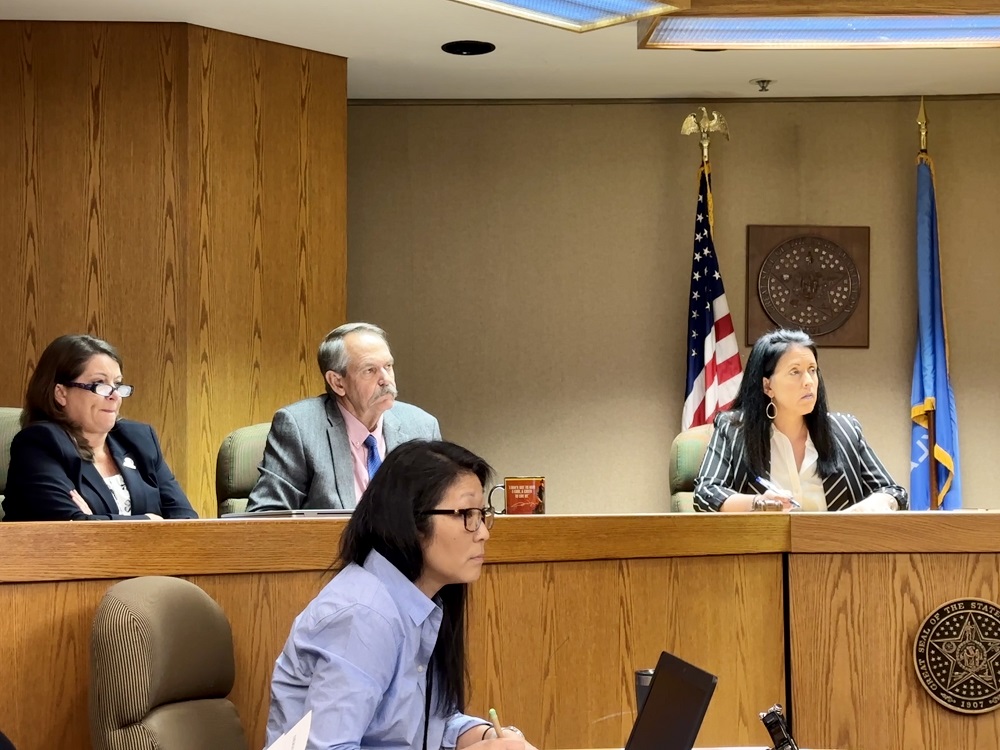
Drought relief is one step closer to being on its way to Oklahoma farmers and ranchers following the second meeting of the Emergency Drought Commission. Commissioners Blayne Arthur, Julie Cunningham and Trey Lam met Friday, September 30, 2022, and unanimously approved a program proposed by the Oklahoma Conservation Commission which will distribute the $3 million appropriated by the State Legislature and approved by Governor Stitt in House Bill 2959 to Oklahoma ag producers.
After the meeting, Ron Hays, Senior Farm and Ranch Broadcaster, caught up with Ag Secretary Blayne Arthur- “I think certainly a longer meeting, but also lots of good discussion,” Arthur said.
The Emergency Drought Commission, Arthur said, values public input from producers and producer groups. While there is not enough money to stretch as far as everyone would like, Arthur said the commission is putting thoughtful consideration into how to address the needs of ag producers and provide them long-term benefits.
“Today, our focus was on several of those items listed from proposal from the conservation commission and lots of things specific to water,” Arthur said. “We will, I anticipate very soon, have another meeting to address a focus on the transport of hay and feed, because we know that is a great need for producers as well, but I think lots of good points were brought up today regarding that proposal and we want to be very thoughtful in what we decide to do so it is the best for Oklahoma.”
Pending final approval by the OCC, scheduled to meet Monday, October 3, 2022, emergency drought cost-share funds will be made available to all 77 Oklahoma counties to be distributed by local conservation districts. Projects included in the program are water well drilling, pumping facilities, pipeline, pasture tap, watering facilities, heavy use protection, cover crop planting, forage and biomass planting (excluding Bermuda grass), and pond clean out(a point of emphasis in the discussion between the Commission and members of the Legislature present).
Arthur said the commission is appreciative of legislative members, and certainly the ag chairman and ag members that helped make everything happen at the capitol. More funds are on the way, she added. That’s in reference to the legislature approving another $20 million on Thursday during the Special Session- that money will move to the Commission’s banking account once that measure is signed by Governor Kevin Stitt.
“That certainly changes our conversation as an Emergency Drought Commission,” Arthur said. “We initially just had the three million, and now as we look toward that twenty million, I think also gives us an opportunity to deploy a lot of dollars, see what works, see what we can improve on, and do an even better job with those dollars as they come our way.”
One of the points of concern raised by lawmakers at the meeting as well as the Michael Kelsey with the Oklahoma Cattlemen’s Association is the statement by Conservation Commission Executive Director Trey Lam that the rules that the Commission and Conservation Districts operate under would not allow any retroactive funding support of projects like pond clean out- and that projects could only be started until the the local Conservation District gives the go ahead- which would not be until mid November at the very earliest. Kelsey indicated to the Oklahoma Farm Report that he had urged Lam after the Commission meeting to ask the Conservation Commission to approve an Emergency Rule at their Monday meeting that would allow earlier work- if done correctly- to receive cost share funds.
As for a time line on having the chance to apply for and receive these cost share funds- Trey Lam tells the Oklahoma Farm Report that if the Conservation Commission does approve the request to operate this project from the Emergency Drought Comission- “the application period should begin around the second week in October and close around November first. Districts should meet, rank and fund the qualifying applications in early November. Hopefully work can start by mid November. All work should be authorized by first week of December for sure. Some districts will move more quickly.”
The Drought Commission stipulated to the Conservation Commission that the cost share max per contract would be 80% with the maximum payment not to exceed $7,500 per project.
It is urgent, Arthur said, that these resources are made available to Oklahoma ag producers quickly we continue to sink further into extreme and exceptional drought.
Arthur said she likes to remind people that it is important to support the small percentage of farmers and ranchers in Oklahoma and the United States because they are the food supply.
“As we help these producers, ultimately that increases our food security, and also access to food and fiber across the United States,” Arthur said.
Click the LISTEN BAR below to listen to Ron Hays and Ag Secretary Blayne Arthur talking highlights from the second Emergency Drought Commission meeting.
Sep 30
Fri, 30 Sep 2022 14:44:31 CDT
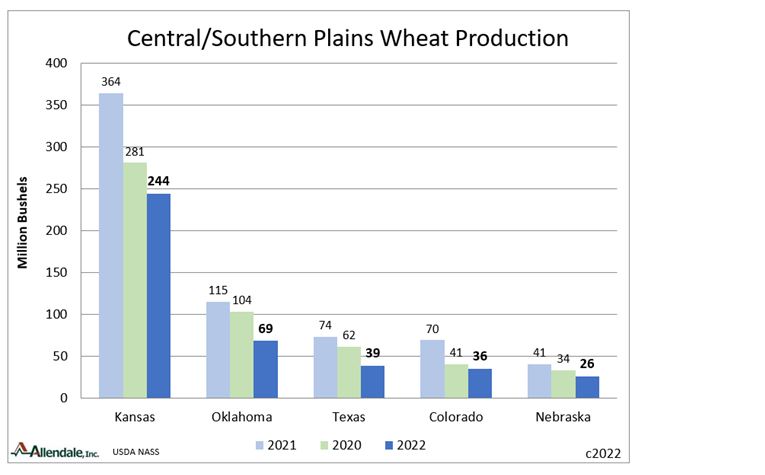
Two USDA reports important for grains are released on September 30, quarterly Grain Stocks and the annual Small Grains Summary. This specific Grain Stocks report is important as the September 1 numbers represent final old crop ending stocks. USDA’s most recent September 12 report used estimated old crop stock numbers. This report includes production revisions for corn and soybeans for the prior 2021 fall harvest. For wheat, September 1 stocks are what is left over after one-quarter of use. The second report, Small Grains Summary, revises the completed 2022 harvest estimates for wheat, barley, and oats.
Farm Director KC Sheperd caught up with Allendale’s Rich Nelson, who says today’s 531 million bushel estimate is the lowest since 1957’s 429. This year’s HRW harvest is -29% from last year. Nelson said the Wheat side is a very interesting story, “They surprised us with a large wheat production revision for this crop we just harvested that going in the bins, 133 million bushel revision for the September report here.” Nelson says this is the largest revision for wheat production they’ve ever done on this report, “They’re smaller winter wheat numbers, smaller spring planted crop numbers as well. One small note, though, is their stock numbers were not that small. They were on the trade estimate. So we’ve got smaller production, but there are some clear signs of some demand issues, which we’ll certainly have to talk about with wheat in the next few weeks.”
Wheat:
2022/23: A significant 133 million bushel decline was made to USDA’s prior 2022 wheat production estimate today. Now at 1.650 billion bushels, it was under the 1.778 trade expectation (ALDL 1.787). This decline was the largest ever for this report. The prior record was an 84 million bushel decline on the 2015 crop. The production decline was positive but it also highlights another problem when looking at the neutral September 1 Grain Stock count. At 1.776 billion it was right on the trade estimate (ALDL 1.813). To make this stock number work it would imply a June – August feed/residual use of only 110 million bushels. That is less than half last year’s Q1 use of 254. For ending stocks, a 50% demand offset to the production change would lower USDA’s prior 610 million estimate down to 546.
Soybeans:
2021 Production: The prior year’s production was raised by 30 million bushels to now 4.465 billion. The trade estimate was 4.437 (ALDL 4.435). USDA has been posting prior year production revisions for soybeans since 2006. Of those there were seven increases averaging 46 million bushels, four decreases averaging 48 million and three making no change. September 1 Old Crop Stocks: 274 million bushels was the final stock number from USDA’s quarterly survey. This was over the 242 trade estimate (ALDL 264). This was a good 34 million bushels over their prior estimate from the September 12 WASDE. This lower old crop stock number flows into the new crop balance sheet. If you assume a 50% offset from demand, as demand changes flow with supply changes, it would raise USDA’s new crop stock estimate from 200 million to 217. That would imply $13.70 for November soybeans. Allendale, with a different demand point, would suggest a 203 million stock and a $13.95 price.
Corn:
2021 Production: The prior year’s production was lowered by 41 million bushels to now 15.074 billion. The trade estimate was 15.091 (ALDL 15.115). This was only the third time the September Grain Stocks report posted a revised prior year production. The prior two were -71 million last year and +3 million two years ago. September 1 Old Crop Stocks: 1.377 billion bushels was the final stock number from USDA’s quarterly survey. This was under the 1.512 billion trade estimate (ALDL 1.504). This was a good 148 million bushels under their prior estimate from the September 12 WASDE. Beyond the production revision, we would compute June – August feed use at 783 million bushels to make this work. That would be 166 million over last year in the same period. This lower old crop stock number flows into the new crop balance sheet. If you assume a 50% offset from demand, as demand changes flow with supply changes, it would lower USDA’s new crop stock estimate from 1.219 billion to 1.135. That would imply $6.90 for December corn. Allendale, with our view of lower demand vs. USDA separate from today’s report, would suggest a 1.166 billion stock and a $6.85 price
The Hogs and Pigs Report was also released yesterday, and Nelson says that report was pretty positive, “The trade had been expecting a very minor decline in these numbers as far as the total hog herd, and keep in mind we’ve been in liquidation for two years prior. This is the third year of light liquidation for the hog side, and we have the smallest hog herd in about five years total. So the trade expected a 0.8% production hog herd decline versus last year; USDA gave him a 1.4% decline. Nelson says On top of that, the trade had expected maybe some of the farrow numbers to start evening out, “In other words, stop the general decline. However, USDA gave us a little surprise: a small decline for the SEP-NOV numbers and a small increase for the DEC-FEB fairing numbers. The bottom line is March through May of next year is still going to look at this roughly even with this year’s low production, maybe even a slight decline, so we’re not in expansion; we’re still at five-year hog-herd lows.”
Nelson said it’s also been a tough week for the cattle market, “They’re looking at three issues. First, we have the issues regarding demand concerns which we all understand with this recession talk. We have two confirmed quarters of declines in US economic growth. So we know that’s a valid issue. The market really hit that here this week. On top of that number two, we have a little bit larger expected cattle kills recently, about 2-3% over last year; that won’t change until we get into November. And the other thing is this; this trade had really been pricing in the belief of a sharp decline in production as we go into q4 or q1. With the six months in a row of minimal change replacements, It looks like that story’s not going to be true. So the cattle side has some pressures still for another, just maybe two to three weeks in front of it. Grand scheme of things, we can expect a moderate rebound maybe as we get into November.”
SMALL GRAINS SUMMARY
All wheat production came in at 1.65 bb for 2022, up less than 1% from the 2021 total. While acreage declined, overall yield estimates increased by 2.2 bpa to 46.5 bpa.
By class, winter wheat production was 1.1 bb, down 14% from last year; other spring wheat was 482 mb, up 46%; and durum wheat production was 64 mb, up 70% from last year.
Hard red winter wheat production was pegged at 530.9 mb, while soft red wheat was 336.5 bb.
Oat production was estimate at 57.7 mb, 45% higher than 2021, while barley production was estimated at 174 mb.
For Oklahoma:
In 2021, Oklahoma planted 340,000 acres of corn and harvested 295,000 acres of corn. Yield per acre for 2021 was 150 bushels per acre and production at 44.2 million bushels. Corn stocks as of June 1, 2022, are at 4.8 million (off-farms).
Soybeans planted in Oklahoma for 2021 is reported at 580,000 acres planted and 535,000 acres harvested. Yield per acre was 23 bushels per acre and production at 12.3 million bushels.
Sorghum stocks (off farms) as of June 1, 2022, in Oklahoma are reported at 3.2 million bushels.
To read more premium content from Allendale, click here:
Click here to hear the complete conversation with KC & Rich Nelson
Sep 30
Fri, 30 Sep 2022 12:16:40 CDT
For the United States, winter wheat production for 2022 totaled 1.10 billion bushels, down 14 percent from the 2021 total of 1.28 billion bushels. The United States yield, at 47.0 bushels per acre, was down …
Sep 29
Fri, 30 Sep 2022 08:46:52 CDT
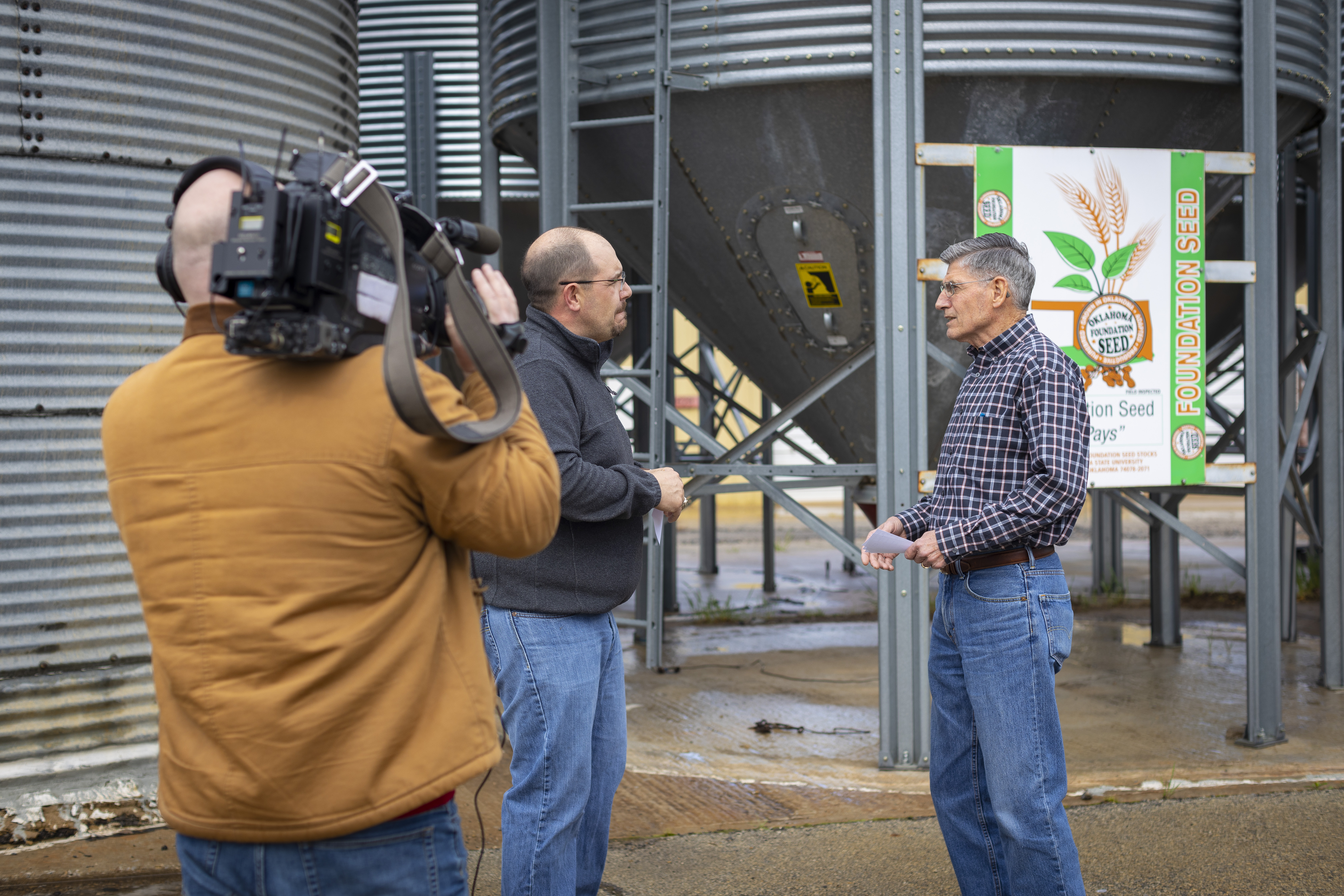
This Week on SUNUP is Oklahoma State University Extension grain market economist, Kim Anderson. During this week’s edition, Anderson talks about the crop markets and factors impacting prices.
“Not much on the surface if you look at the crops,” Anderson said.
Wheat prices moved down towards the end of last week and into this week, Anderson said, and have been dependent on Russia and Ukraine.
Putin is unpredictable, Anderson said, so there is a lot of uncertainty over there.
“If you look at corn, it has been trending down just a little bit,” Anderson said. “Our harvest is 18-20 percent complete.”
In the news this week, Anderson said, is that Mexico announced that in the future they will not be accepting genetically modified corn as we get into 2024 and 2025.
“Then you have got Ukraine that is moving product out and they are a big corn exporter, and right now they are not having an impact on prices, but you shut that off and it could have an impact,” Anderson said.
Soybeans have been trending down the last couple of weeks, Anderson said, and Argentina has been seeing more beans than usual, and they have been selling them to China. China has been ignoring the U.S., he added, and that is one reason those prices have been going down.
“Cotton over the last month or so has moved from $1.20 down to 88 cents for a pound of cotton,” Anderson said. “I think it is that dollar value going from 98 up to 113 or so.”
Then you’ve got world cotton production that is relatively high, Anderson said, and U.S. cotton production that is low.
“If you are looking at wheat, you have got the Argentina and Australia harvest,” Anderson said. “A relatively large harvest in Australia and the average harvest in Argentina. Those harvests will start in the next 6 weeks or so. Something could happen there that would impact prices.”
The dollar is up to 113 now, Anderson said, so if that will back off, it could help move prices up. If it keeps going up, he added, we will have problems exporting our wheat.
This week on SUNUP:
• Seth Byrd, OSU Extension cotton specialist, gives an update on how the cotton crop is faring during drought.
• Wes Lee, OSU Extension Mesonet agricultural coordinator, predicts La Nina likely will continue into early winter. State climatologist Gary McManus analyzes the latest drought monitor.
• Misha Manuchehri, OSU Extension small grains weed specialist, says even though the extremely dry conditions may delay winter weeds, producers still need to plan ways to control them.
• Derrell Peel, OSU Extension livestock marketing specialist, discusses how the drought is impacting auction volumes in the cattle markets.
• Mark Johnson, OSU Extension beef cattle breeding specialist, explains how manage body condition scores in beef calves.
• Rodney Jones, OSU Extension ag finance and management specialist, invites viewers to the upcoming Rural Economic Outlook Conference.
• We preview the upcoming Rural Renewal Symposium.
• Kim Anderson, OSU Extension grain marketing specialist, discusses the effect of Russia’s war with Ukraine on the overall crop markets.
• Rosslyn Biggs, OSU Extension beef cattle specialist, says cattle producers need to be on the lookout for obstructions in their herd this time of year.
Join us for SUNUP:
Saturday at 7:30 a.m. & Sunday at 6 a.m. on OETA (PBS)
YouTube.com/SUNUPtv
SUNUP.okstate.edu
Sep 29
Thu, 29 Sep 2022 22:07:59 CDT
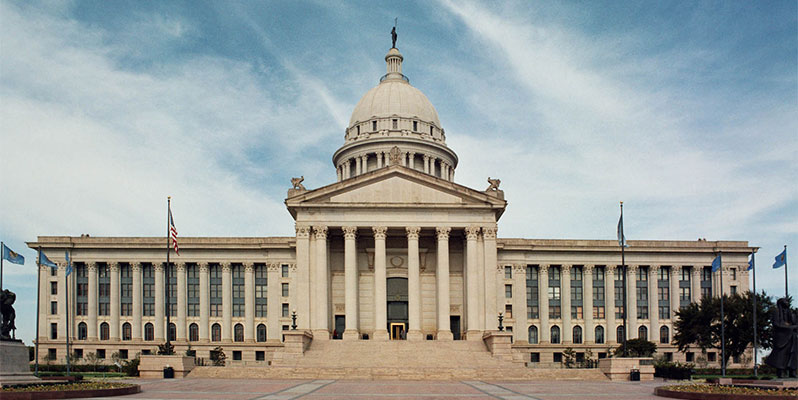
The Oklahoma Legislature has appropriated $20 million to aid the agriculture industry across the state during the ongoing drought.
House Bill 1006XX designates $20 million to the Emergency Drought Relief Fund from any monies not otherwise appropriated from the General Revenue Fund of the State Treasury. During the regular session in the spring, lawmakers also approved House Bill 2959 to designate $3 million for the fund.
The fund was created in 2013 to provide funding for emergency drought relief activities once a drought emergency has been declared. Funds must be expended solely on efforts to relieve drought conditions.
Earlier this month, Gov. Kevin Stitt issued an emergency drought declaration to reactivate the emergency drought commission, which will determine how legislative appropriations are used. The commission is comprised of members from the state’s agriculture, water resources and conservation agencies.
HB1006XX was presented on the House floor Thursday morning by Rep. Dell Kerbs, R-Shawnee.
“The vast majority of farms in our state are family-owned, many of which have been operating for generations,” said Kerbs, who chairs the House Agriculture and Rural Development Committee. “We need to take care of our farmers and ranchers because they’re the ones who take care of us, and this bill gave us an opportunity for the legislative body to help those in need now while also mitigating future situations.”
Data from the U.S. Drought Monitor shows over half the state is facing extreme drought, while nearly 14% of the state falls under exceptional drought, the highest level.
“Farmers and ranchers in our state are struggling with the ongoing drought,” said Sen. Roland Pederson, R-Burlington, who serves as vice chair of the Senate Agriculture and Wildlife Committee. “Because of no fault of their own, some are being faced with the possibility of giving up on their livelihoods. We must do what we can to help them get through this difficult time. This money will go a long way to this worthy goal.”
HB1006XX passed both chambers overwhelmingly and will move to the governor’s desk for consideration.
Sep 29
Thu, 29 Sep 2022 14:48:40 CDT
Click here to listen to audio
Farm Director, KC Sheperd, got to chance to visit with Secretary Ryan Walters on some hot topics concerning education in Oklahoma as he runs for state superintendent.
O…