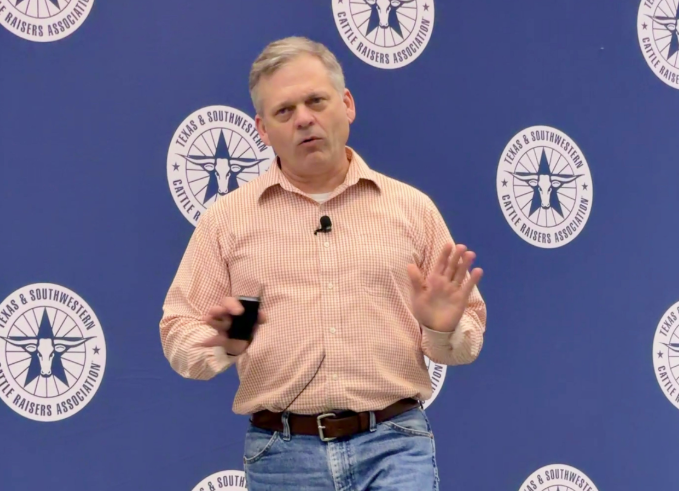
In today’s Beef Buzz, senior farm and ranch broadcaster Ron Hays speaks with Lee McGlamery of MP AgriLytics, who shares insight on key market forces shaping the cattle industry—from Mexico trade uncertainty to rising carcass weights and shifting demand. McGlamery was one of the featured speakers at the 2026 Texas and Southwestern Cattle Raisers Convention in Ft. Worth, Texas.
Mexico Cattle Flow Likely to Stay Limited
McGlamery says expectations for Mexican cattle imports returning to previous levels remain low, citing both political and economic factors.
“to me, I think there’s some political issues,” McGlamery said. “I also believe that some of the internal interests in Mexico certainly want to keep those cattle at home.”
He added that incentives within Mexico’s packing sector are also playing a role. “I think packing industries made a lot of money off those cattle not being able to move to the U.S., so I think there’s limited desire on their side to send those cattle.”
Even if trade resumes, he doesn’t expect a surge in numbers. “That would be our guess, because Mexico is in the process… of expanding some of their packing capacity… as well as building more feed bunks.”
Beef-on-Dairy Continues to Reshape Supply
McGlamery points to beef-on-dairy as one of the most significant structural changes in the industry.
“Yes sir, it’s been a huge game changer,” he said. “We’ve seen significant growth over the past five to seven years.”
That growth is now showing up clearly in feedlot data. “You’ve got upwards of probably 25% of what’s on feed has some sort of dairy influence right now.”
Strong Demand Holds Firm Post-COVID
Consumer demand for beef remains a major supportive factor in the market, according to McGlamery.
“Yes, sir, it really even started prior to COVID, but COVID really seemed to launch it, they went parabolic,” he said.
He attributes that surge to lifestyle and economic shifts during the pandemic. “The consumer staying at home, having more discretionary income, we also had some government stimulus programs.”
More importantly, he says those habits have stuck. “Once it changed, we’ve not gone back, we’re just not willing to back away from beef at this point.”
Market Nearing Its Peak
While demand has remained strong, McGlamery believes the cattle market may be approaching its high point.
“My bias is we’re very close,” he said. “I obviously can’t call a date but I do believe we’re near the top right now.”
He explained that prolonged tight supplies have extended the cycle. “It’s been more of a ‘U bottom in supply’… than just turning around and having a V bottom that goes straight back up.”
Carcass Weights Climbing Rapidly
Another major trend is the continued increase in carcass weights, which is helping offset lower slaughter numbers.
“Yeah, we’re running anywhere from 40 to 50 pounds above year ago right now,” McGlamery said.
Looking ahead, he says the increase could grow even more. “We could be potentially looking at carcass weights that are 80 to 100 pounds above year ago.”
However, there are limits—especially as summer approaches. “We’re very concerned about a summer situation, if we’re dealing with heavy, heavy animals… death loss becomes a problem.”
He adds that while feeding cattle longer has been profitable, it may not last indefinitely. “It feels like we’re going to reach the end of our rope at some point.”
McGlamery says a combination of supply constraints, strong demand, and operational challenges will continue to shape the cattle market in the months ahead, with several key variables still in play.
The Beef Buzz is a regular feature heard on radio stations around the region on the Radio Oklahoma Ag Network and is a regular audio feature found on this website as well. Click on the LISTEN BAR above for today’s show and check out our archives for older Beef Buzz shows covering the gamut of the beef cattle industry today.