
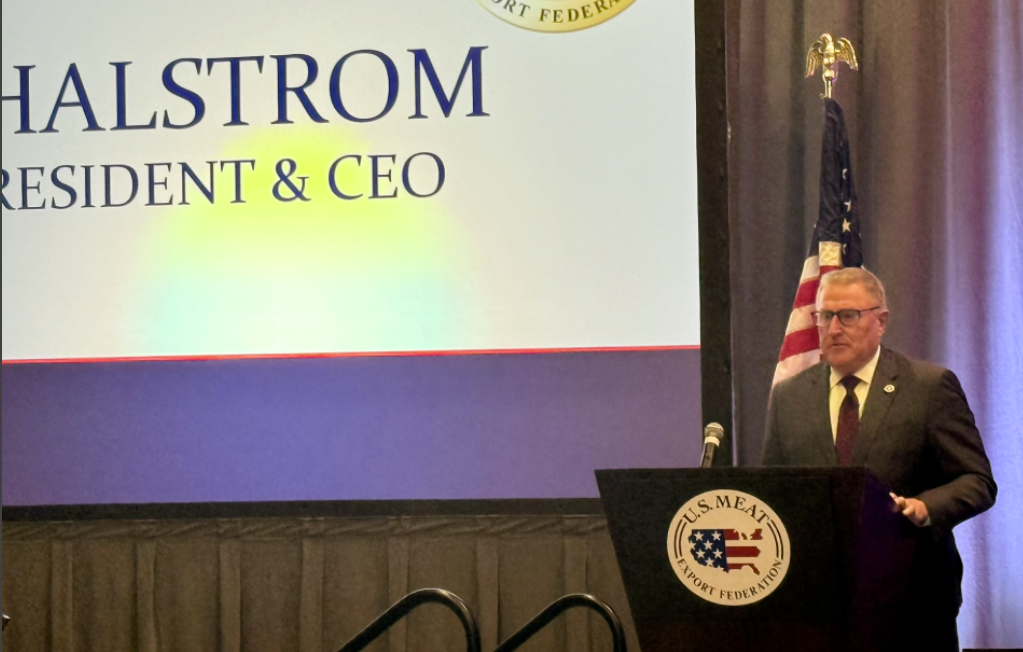
In today’s Beef Buzz, senior farm and ranch broadcaster Ron Hays features comments from Dan Halstrom, president and CEO of the U.S. Meat Export Federation who spoke at the spring conference, about renewed optimism surrounding U.S. beef access to China after American cattle producers have been effectively shut out of the market since early 2025.
Why China Matters for U.S. Beef
China has become one of the most important export destinations for U.S. beef over the last several years, after trade negotiations during President Trump’s first administration opened the door through the Phase One trade agreement.
The market quickly became a major buyer of American beef. U.S. beef exports to China reached approximately $1.5 billion in 2021, climbed to a peak of $2.14 billion in 2022, and remained strong in both 2023 and 2024 before access problems began disrupting trade in 2025.
Halstrom said recent developments tied to a high-level meeting between President Donald Trump and Chinese President Xi Jinping could mark a turning point. “Well, I had a bunch of interviews week before, and I kept getting the question, ‘Will beef open? Will beef open?’ and I said, ‘I don’t know, I hope so,’” Halstrom said. “But in my opinion, it took some sort of a landmark event for it to happen.”
Halstrom said for months he believed only the top leaders of both countries could resolve the impasse. “I’ve been saying all along that there’s probably one or two guys that know — well, those are the two, Trump and Xi together,” he said.
A Breakthrough, But Not a Full Resolution
According to Halstrom, recent talks appear to have delivered meaningful progress. “Sure enough, we were told that USTR had — of course soybeans were number one on the list — but they said beef was right there,” Halstrom said. “By golly, they got it done, so we got the 425 plants relisted.”
Still, the reopening is not complete. “We still have 25 that are suspended for a different reason around residue violations, but there’s a commitment to work on that quickly,” Halstrom said. “So I feel pretty good about things after hearing that. The report we got back from Ambassador Greer and USTR in general was very positive.”
Halstrom emphasized that optimism is growing, but implementation matters. “We still have plants that are suspended, though, for separate violations that involve residue testing or residue levels,” he said. “This is another area that’s a little bit difficult to deal with.”
He added that while residue concerns were discussed during meetings, more technical work remains. “While it wasn’t solved in the meetings last week, it’s going to be focused on here in the very near future,” Halstrom said. “So that’s a pretty optimistic readout. We’re pretty happy with that week, but now the follow up is the key.”
Technical Challenges Remain
In a reminder from an earlier conversation with USMEF vice president of economic analysis Erin Borror- Hays was warned that even if political leaders reopened the market, technical barriers could still prevent beef shipments from resuming smoothly. “A lot of our biggest plants are among those 30 that are suspended,” Borror explained. “So that is one of our fears, is that it would be easy to have a high-level meeting and say, ‘All right, yeah, we’re going to reopen the beef market,’ they just update the cipher, and we are still stuck.”
Borror said suspended facilities represent some of the industry’s most critical production capacity.
“Having again a lot of our really important big plants being out suspended, and we also have other residue issues that China has politicized,” she said, “there would be a fear of, can we even ship for those that are not suspended and would have been relisted?”
Because of that, she described the challenge as more than just a diplomatic issue. “There’s still really at least a twofold layer of technical engagement that’s needed,” Borror said. “And that’s about these residue issues, which is actually kind of tied to an ability to relist suspended facilities.”
Customers in China Are Ready for U.S. Beef
Even with lingering hurdles, Halstrom said demand for American grain-fed beef in China remains strong and buyers are prepared to move quickly if shipments resume. “I’m guessing what will happen is, packers are at risk- they’re going to be slow on going about it methodically,” Halstrom said. “But if there’s a chance to start shipping beef, they’ll do it.”
Halstrom said USMEF’s team in China reports eager customers waiting for American products to return. “We can tell you this — the marketplace, our office in China, we have customers ready to go now,” he said. “We got Sam’s Club, the largest big box retailer in China. They are ready to go.”
In the meantime, Chinese retailers have turned to alternative suppliers. “They’ve had to use Australian with our absence,” Halstrom said. “And they’ve told us, quite frankly, their business is down. It doesn’t move like U.S. grain-fed beef, of course.”
The Beef Buzz is a regular feature heard on radio stations around the region on the Radio Oklahoma Ag Network and is a regular audio feature found on this website as well. Click on the LISTEN BAR above for today’s show and check out our archives for older Beef Buzz shows covering the gamut of the beef cattle industry today.