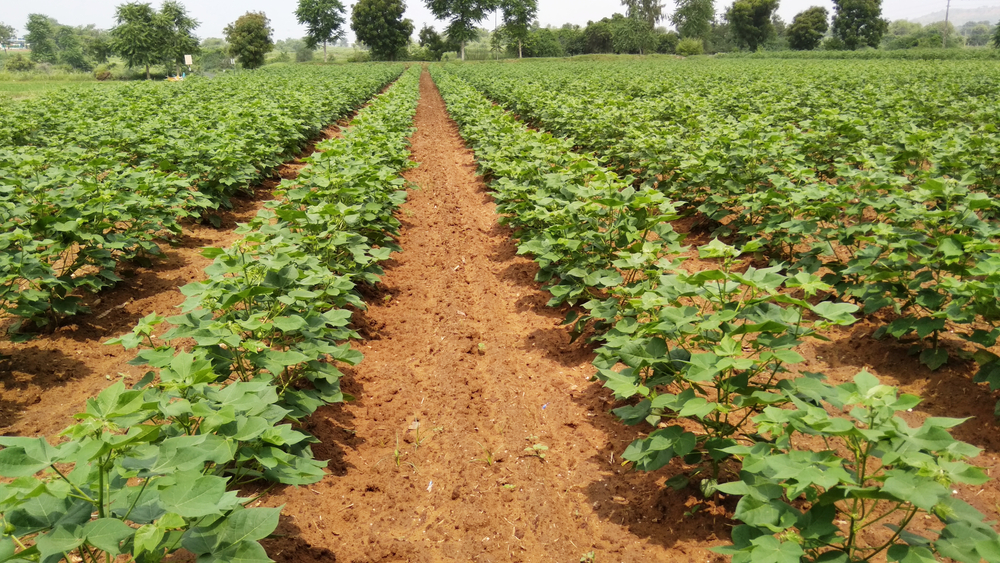
As the summer progresses, finalizing planting and navigating unexpected weather shifts have made early-season cotton management a top priority for producers across the region. Farm Director KC Sheperd recently caught up with Oklahoma State University Cotton Extension Specialist Jenny Dudak to discuss the current state of the crop, critical weed and insect strategies, and an exciting new collaborative research project.
According to the latest June crop progress numbers, approximately 63% of the cotton crop has been planted. However, Dudak noted that progress might be slightly further along in certain areas.
“The last report that I got from Southwest Oklahoma, we are probably about 75 to maybe 80% done down there,” Dudak said, explaining that dryland acres are currently driving the remaining planting activity. “We’re past the insurance date for our irrigated crop. So folks are just trying to work on getting those dryland acres planted and in the ground.”
Navigating Soil Moisture and Early Weather Hurdles
Recent rainfall has provided much-needed support for the remaining dryland acres, particularly in Southwest Oklahoma. However, balancing the moisture with timely planting remains a delicate task.
“Trying to get our seed in the ground without letting the soil dry out too much, it has been pretty critical,” Dudak observed. “So I think those guys are kind of working around the clock to try to get things done.”
The early spring season also brought unusual cooler spells, raising concerns among producers about potential seedling diseases and cold shock. While Dudak has not received any official reports of seedling disease resulting from the cold snaps, the weather did present other challenges.
“Mainly what I was concerned about is that soil temperature dropping a little bit,” Dudak stated. “Because it was cold a few days in a row, and so that can drop our soil temps a little bit, and emergence was mainly what I was worried about with that cold spell.”
Fortunately, early indicators from the field are positive. An on-farm race trial planted in Caddo County during the cold spell is reportedly on track and looking good, giving producers a reason for optimism.
Weed Management and Herbicide Stewardship
Effective weed management remains a cornerstone of a successful cotton season, particularly during the critical weed-free period. For producers who were able to plant earlier, the focus is now shifting toward post-emergence applications.
Dudak strongly advocates including a residual herbicide in early post-emergence treatments to extend control.
“When we put out our early post, we are also putting out a residual with that early post,” Dudak recommended. “Some of our Group 15s, products like Warrant, Dual, or Outlook, are good options to kind of hold some of those weeds back a little bit longer, extend that critical weed-free period.”
For growers still working to get dryland acres into the ground, Dudak emphasized the importance of starting with a clean field. This can be achieved through a burn-down application or by applying a residual herbicide immediately behind the planter. Tank mixing is another viable strategy, provided it aligns with the farm’s profitability margins.
With the Dicamba label operating under short-term terms, stewardship remains a top priority for the industry. Dudak urged producers to remain diligent and informed.
“The best advice that I’ve got, I know it’s not easy, but follow the label as closely as we can,” Dudak stressed. “Just making sure that you’re up to date with the new label and following those rules as the label states to try to maybe prolong our chances of continuing to use Dicamba.”
Insect Pests: Thrips and Fleahoppers
Early-season insect scouting is vital to protecting young cotton plants. Thrips are a perennial concern, especially during cooler periods when plant growth slows down. However, the recent shift toward hotter weather has allowed cotton plants to grow rapidly, naturally reducing the window of threat for thrips. Dudak noted that once cotton reaches five true leaves, producers can safely discontinue scouting or spraying for the pest.
As the season progresses, the scouting focus must shift to other emerging threats.
“Some of those guys that kind of planted a little bit early, you might start thinking about scouting for fleahoppers,” Dudak advised. “Making sure you put that on your radar. As soon as your plants start squaring, that’s when you need to start thinking about fleahoppers and fleahopper management.”
Innovative Variety Trials at Altus
Looking ahead, Dudak is spearheading an exciting collaborative research project that spans nearly the entire Cotton Belt. The trial, located at the Altus Research Station, involves cotton specialists from every producing state except Florida and focuses on Extra-Long Staple (ELS) qualities.
The comprehensive study compares a Pima variety, various hybrids, breeding lines from Texas A&M and private industry, and commercially available Upland varieties known for long staples. The old-faithful variety, Delta Pine 1646, serves as the control.
“We are going to run all of those samples at the end of the year after we harvest through a saw gin and also through a roller gin,” Dudak explained. “And then we’re going to be doing some economic comparisons, some loose return on investments, and see what the viability of running some of our Upland varieties through a roller gin might be.”
This research addresses a highly discussed topic in the region, as several Oklahoma producers have recently experimented with or considered roller ginning Upland varieties. The study aims to provide the cotton specialist group with data-driven insights to better answer producer inquiries as interest grows.
The Altus Research Station trials are open to the public for visitation throughout the summer. Producers interested in viewing the plot map or scheduling a field visit are encouraged to contact Jenny Dudak directly. Comprehensive data and findings from the trial will be made publicly available following the year-end harvest and analysis.