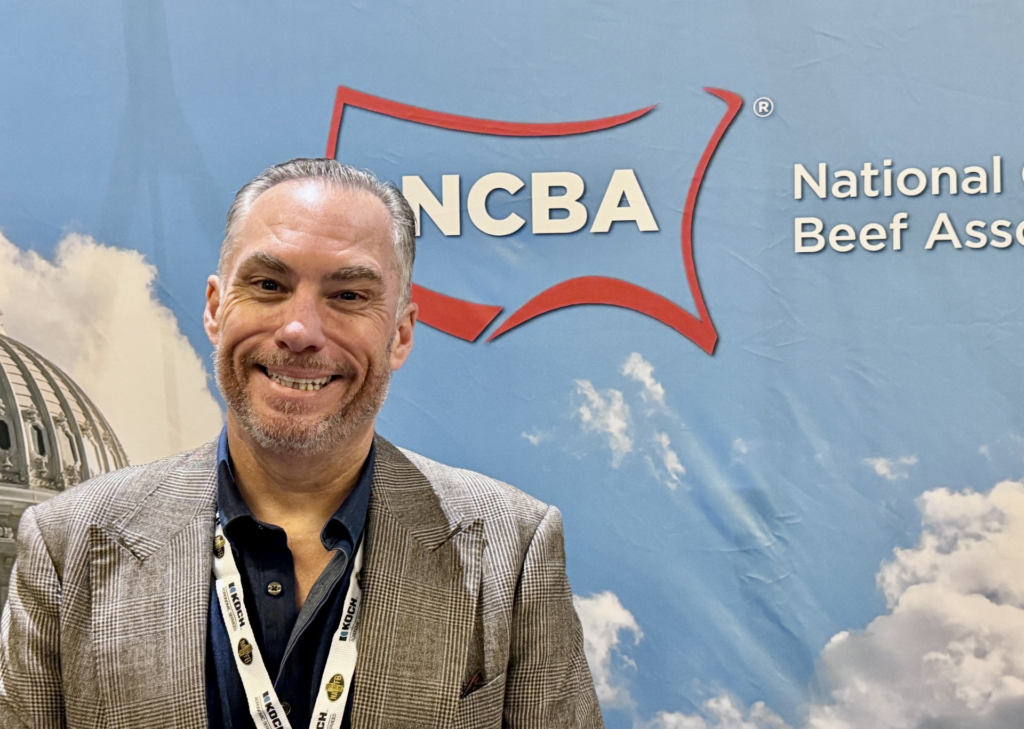
In today’s Beef Buzz, senior farm and ranch broadcaster Ron Hays spoke with Ethan Lane, head of the Washington, D.C., office of the National Cattlemen’s Beef Association (NCBA), during the 2026 National Farm Broadcasters Annual Meeting in Kansas City. The two discussed the possibility of moving a farm bill forward during the lame-duck session of Congress, the political landscape following the midterm elections and how recent enforcement actions involving the cattle industry may have affected voters in farm and ranch country.
Farm Bill 2.0 Faces an Uphill Battle
With lawmakers considering whether to take another run at completing a farm bill before the end of the year, Lane said the political environment in Washington makes the path forward difficult. “I continue to say what I’ve been saying for the last few years. It is a very tough environment. I might say it’s even tougher now than it has been,” Lane said.
While some longstanding issues, including Supplemental Nutrition Assistance Program (SNAP) provisions, may be moving closer to resolution, Lane said there are still significant obstacles. “There’s always a chance that they can get some things together,” Lane said. “It’s a tough landscape, and there are not very many days left. And this process is a complicated one.”
Lane said there are still major disagreements surrounding the Senate version of the farm bill, including provisions that were not addressed during committee markup. “Beyond the poison pills already in the Senate draft, there’s a whole host of stuff. You know, really crazy stuff that didn’t get entertained in the committee markup,” Lane said.
He added that some lawmakers will want the opportunity to publicly address their disagreements, making it even harder to streamline the legislation and move it through Congress.
Lane also questioned how much motivation newly elected Democratic senators from traditionally agricultural states might have to reach an agreement before the balance of power shifts. “I don’t know that I’d be anxious to give away the farm right now, knowing that there’s a new day coming where they’re going to be able to perhaps craft some of this stuff the way they would like to see it,” Lane said.
Midterm Elections Reflect Frustration in Farm Country
Hays also asked Lane about the significant political changes seen in the midterm elections and what those results could mean for agriculture moving forward.
Lane said he believes frustration with the White House and the current administration played a role in the election results, with some traditional Republican voters choosing not to participate or supporting moderate Democratic candidates. “What we saw in these midterm elections was a lot of frustration with the White House, a lot of frustration with Republicans in power right now, a lot of displeasure with the populism that we’ve seen from this administration,” Lane said.
He pointed to newly elected Democrats in traditionally Republican states, noting that some campaigned on positions that could appeal to more moderate voters.
Lane also said the economic pressures facing agriculture were part of the broader frustration reflected at the polls. “Across the board, a lot of voters clearly either were not willing to show up or not buying what the administration was selling here, and a pretty bad taste in the mouths of the farm economy across the country, I think, and that was reflected at the polls,” Lane said.
Immigration Enforcement Actions Draw Concern in Cattle Country
The conversation also turned to the Kansas Senate race and the impact of immigration enforcement activity in southwestern Kansas, particularly around packing plants and feedlots.
Lane questioned the decision to conduct enforcement actions at agricultural facilities without warrants while the cattle industry was also facing public pressure over high beef prices. “I don’t really understand what the political calculus was there, but I do think that it probably cost them at the polls,” Lane said.
He explained that packing plants and feedlots are important parts of the agricultural economy in those communities, and disrupting those operations can have consequences for the people and businesses that depend on them. “When the backbone industry of an entire area is needlessly messed with, you know, for political points, shocking that the people in that area don’t respond well at the polls,” Lane said.
Lane added that NCBA and others had raised concerns about the potential impact of those actions before the election. “Certainly, we sort of saw it and tried to point that out. That, hey, this is maybe not the smartest way to use your time right now,” Lane said. “But actions have consequences, and certainly that one did.”
The Beef Buzz is a regular feature heard on radio stations around the region on the Radio Oklahoma Ag Network and is a regular audio feature found on this website as well. Click on the LISTEN BAR above for today’s show and check out our archives for older Beef Buzz shows covering the gamut of the beef cattle industry today.