
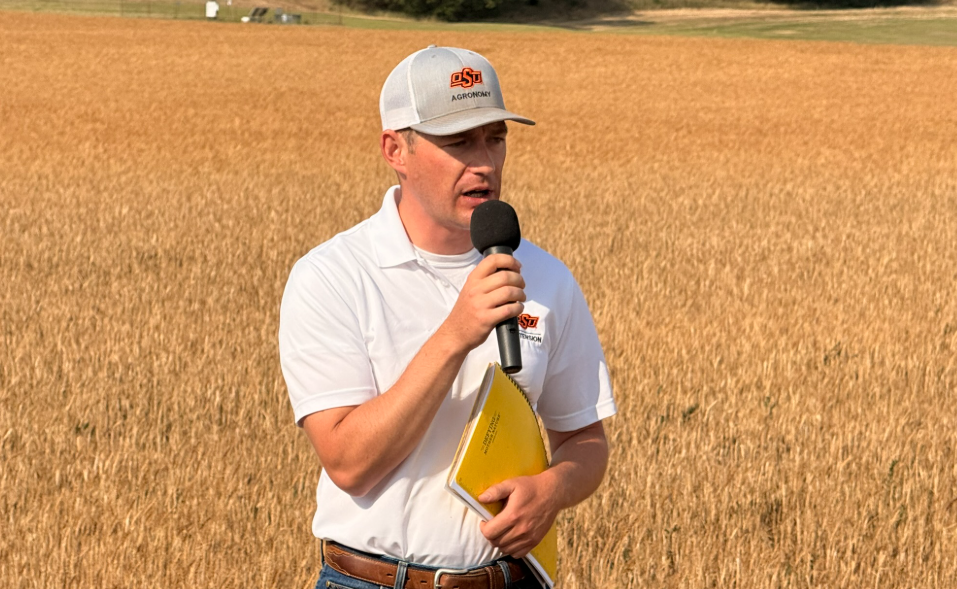
Producers across Oklahoma are constantly looking for innovative ways to manage rising fertilizer costs while maintaining productive fields. At the recent Oklahoma Wheat Field Day, Radio Oklahoma Ag Network Farm Director KC Sheperd caught up with Daniel Adamson, Oklahoma State University Extension soil management specialist, to discuss a promising proof-of-concept study focused on rebuilding Oklahoma soil health. The research explores the long-term fertility and soil health benefits of applying a single, heavy manure load to western Oklahoma wheat fields, offering a strategic alternative to traditional synthetic inputs during periods of global market volatility.
“Wheat country is a nutrient-exporting part of the state, right?” Adamson explained. “So, every bushel of wheat goes somewhere else, people consume that, in that wheat are nutrients, right? Phosphorus, especially, is one of concern.”
Because nutrients are continually hauled away at harvest, producers face a structural challenge in keeping their ground fertile. “We’re constantly moving phosphorus out of our wheat fields towards cities or things like that, and it’s hard to get that phosphorus back in,” Adamson said. “We depend on synthetic fertilizer to do that.”
To break that cycle, researchers are looking at alternative, organic nutrient sources that can be trucked into the region. “If we can source other material, manure being something that could bring phosphorus back in, that could potentially be very beneficial long term,” Adamson noted. “The problem is it’s expensive, right? It’s heavy, it’s hard to truck. Most of our poultry production is in the eastern half of the state, and a lot of our feedlots are in the panhandle. So, wheat country is far away from that.”
Despite the logistical hurdles, shifting economics are making these organic options much more attractive. “On years like this year, when phosphorus prices are getting high again because of some global unrest, we need to be thinking about long-term strategies, not only about soil fertility, but also about soil health,” Adamson said. “And manure can give that load of organic matter that can really help these arid western soils as we have in wheat country here.”
The ongoing study aims to demonstrate that a massive, one-time application can deliver sustained returns for decades, thereby justifying the high initial investment. “What we’re doing is a proof of concept,” Adamson explained. “We want to see if there’s any merit to applying a heavy load once and then potentially not having to go back to it for a long time.”
If the concept proves successful, it will completely change how producers calculate the value of hauling manure. “That might help, although it’s expensive the first year, it could potentially help pencil out this long-term strategy of can we get more material in the ground that allows the soil to function at a better fertility status and better soil health status for maybe even a couple of decades,” Adamson said.
Data from surrounding regions suggests that this long-term resilience is entirely possible. “We’ve seen some research out of Montana, Wyoming, and Utah that suggests that they can still measure improvements in fertility and soil health measurements two decades after they applied manure just once,” Adamson noted. “So, that’s what we’re looking at.”
While the Oklahoma study is still in its early stages, the initial visual and chemical indicators are highly encouraging. “We don’t have any yield data yet this year,” Adamson said. “We did see some early-season vegetation changes, and of course, we picked up an increase in a lot of different soil nutrients. So, obviously, the big three—nitrogen, phosphorus, potassium—but we also saw micronutrients increase as well.”
Beyond simply feeding the crop, moving poultry litter from the lush eastern side of Oklahoma to the drier western fields solves two regional agricultural challenges at once. “Yep, that’s a classic problem, and it’s good to just move that nutrient load west,” Adamson said. “A, because we can use that nutrient out here, and B, then it doesn’t become an environmental problem in our streams and lakes and things like that. But again, it’s heavy, so it takes resources to move that west.”
For producers interested in utilizing poultry litter, Adamson emphasizes that proper management and precise spreading are critical to achieving the best results. “When you’re working with organic fertilizers, manures, right? It’s not as uniform an application as urea, DAP,” Adamson said. “Poultry litter is an easier product to spread, and if you are going to spread poultry litter in the state, you need to work with a certified applicator. So, those are folks who know what they’re doing. They will help you with the nutrient management plan of that application, and ideally, you can see some nice, pretty even responses from that application.”
As commercial fertilizer prices remain a volatile variable for farm budgets, shifting the focus toward long-term soil biology offers a buffer against global uncertainty. “Long-term soil health is a long-term strategy, right?” Adamson concluded. “And hopefully, it’s something that helps make our soils and cropping systems more resilient and kind of ride out these periods of time when markets are unpredictable.”
Successfully managing this transition requires an understanding of the unique history of each piece of land, as the legacy of past management dictates how quickly the ground can recover. “I have learned a lot about Oklahoma,” Adamson said. “It’s a fascinating state with the history of the Land Run, how different parts of the state were farmed, and how that legacy remains. And how your soil developed and how it was treated in the past is really something that’s important to think about. So, rebuilding will depend on how that soil has been treated in the past. Some will take more TLC, some can respond really quickly. So, those are things to keep in mind, something I’d like to work on for the next several years.”